Showing posts with label my writing. Show all posts

Monday, April 13, 2015

Wordsmith Anniversary!

Happy 3rd Anniversary, Wordsmith Studio!


For those of you who don't know, Wordsmith Studio is a place where creative minds go to get inspired and keep their creative muse entertained and challenged. There is a veranda for fiction, nonfiction, poetry, and multi-media where you can hang out as you please. You can read more about their mission on their website at www.wordsmithstudio.org

I've been a member of Wordsmith Studio since its inception in 2012. It all started on April 1, 2012 when I discovered Robert Brewer's 30-day Platform Challenge on Twitter. Many of the participants decided to keep the momentum going with the friendships that were formed. This led to the creation of Wordsmith Studio.


Artwork created by Khara House

For Wordsmith's 3rd Anniversary, Wordsmith is holding a reunion via a blog hop. Some of us have moved on to do other things, while others remained; some active, others (like me) pop in and out. The reunion is a wonderful idea because we get to see what others have been up to. 

Here's the 411 on me with Q and A provided by Wordsmith:

What are you writing?
I write nonfiction for children and picture books. Robert Brewer's Platform challenge and the support of Wordsmith helped me get out of my comfort zone to explore the kidlit community through Facebook, LinkedIn, and Twitter (to name a few). I've met some wonderful people in the kidlit community. If you are a picture book writer or are considering it, here are the groups I belong to that provide valuable resources for picture book writers. 

Kidlit 411
Sub It Club
GROG


What are you currently working on?
I've got at least 10 work-in-progress picture books in various stages. Some are simmering (waiting to be looked at with fresh eyes), some are cooking (currently in editing/revising mode), and some are being plated (in preparation for submission).  

I also critique fellow picture book writer's works on a regular basis. I belong to three critique groups and critique a minimum of 6 picture book manuscripts a month. Joining a critique group is one of the most important things I've done as a writer. In my blog, I write about the value of critique groups

Aside from writing and critiquing, I am constantly reading! I read picture books, both nonfiction and fiction. You can find me on Goodreads. Feel free to stop by and see what I'm reading.


What's the biggest thing you've learned from your writing?
1) The more you write, the greater your chances of finding that gem that will lead you to a contract. It's a subjective business so the more stories you have, the better your odds at finding the love connection between agent/editor and your manuscript.

2) It's all about numbers. I learned that my latest story is almost always better than the last one I've written. How many times have you written a story only to re-read it after a few years (or even months) have passed only to say, "Oh, this isn't as good as I thought it was." So keep writing!

Have you made any lasting connections through Wordsmith? (I added this question)
I have to give a shout-out to the friends I've made through Wordsmith. They are all kind and generous people. The friends I've formed a special bond with are:

Lauri Meyers- my fellow picture book writer and Wonder Twin. We hang out in the same kidlit community, shop at the same kidlit stores, and have similar taste in books. She knows my inner most darkest secrets. Okay, not really. I don't have any secrets, but she knows how I think and how I write. She critiques me...in a good way.

Jennifer Chow- my Asian inspiration. I had the opportunity to meet up with Jennifer when she visited San Francisco. Jennifer, Amy, and I got together for lunch to get to know one another. Her award-winning novel, 228 LEGACY, inspired me to write a cultural nonfiction picture book.

Amy Pabalan- my close friend (yes, real close that we live only a few miles from each other) and adviser. We try to meet every so often to talk shop, talk about life in general, and get inspired. I feel so blessed to have met Amy through Wordsmith. She's my buddy, my home-away-from-home kinda gal. When I need a break from writing, we get together for tea (coffee for her).

Lori Sailiata- my Hawaiian sistah from anothah mistah! She lives on Oahu, where I'm from. I had the opportunity to meet Lori in person too when I went back home to Hawaii. She is the co-owner, content creator, and new media strategist at Hawaii Content Marketing. She and Amy have been so helpful and supportive when my e-Book came out. They introduced me to Twitterview. Lori is my go-to person for my author platform questions.


Wordsmith Studios- where connections are made. Thanks for stopping by!

Curious about what Wordsmith Studio has to offer? Want to see what other Wordsmith Studio members are up to? Then check out the link below.


Powered by Linky Tools
Click here to enter your link and view this Linky Tools list...

Wednesday, October 1, 2014

Mentor Text and Readability Scores

It's been a while since I've posted on my blog. It's because I've been burying myself in nonfiction picture books!  


I blame Kristen Fulton's wonderful nonfiction picture book writing class, Nonfiction Archaeology, for my fixation. 

I am familiar with writing nonfiction for magazines, but writing nonfiction picture books is a different animal for me. To help me get into the zone, I've immersed myself in nonfiction picture books. Below are few of my favorite (recent) reads that I am using as mentor text. 


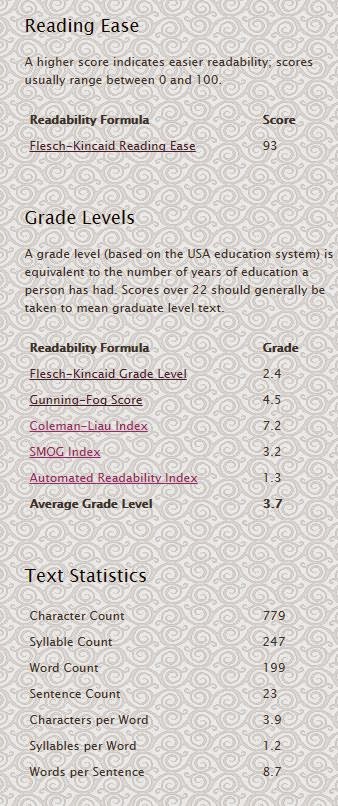
What I find challenging is writing for my target population. It's so easy to want to present all the facts that sometimes I get carried away with words. To make sure I stay on track, I found a wonderful site that helps me assess my work-in-progress:  http://www.readability-score.com


What you do is copy and paste your completed text in the box and hit enter on your keyboard. The site will analyze your story and give you the following information:


What's useful about this information is that you will know if your writing is targeted to the population you intended to write for. 

The Flesch-Kincaid Reading Ease tells you the difficulty of your text:

90.0-100.0 Easily understood by an average 11-year-old student
60.0 - 70.0 Easily understood by an average 13-15-year-old student
0.0 - 30.0 Easily understood by a university student

Grade Level or Readability Formula Score: There is a mathematical way to determine these scores. You don't have to get caught up with each of these. All you need to know is the average grade level of the student your text is appropriate for.

Text Statistics is always fun, but the most useful is word count and words per sentence. As a writer, you want to make sure you vary your sentence length and keep within the word count that is suggested on submission guidelines. 


Here are a few more sites I found helpful for studying mentor text:

  1. Identify whether you are a student, parent, teacher, or librarian (it doesn't matter)
  2. In the "Quick Search" tab, enter the title of the book you are studying
  3. Your result will look like this: 
  4. Click on the title and you get an expanded form of the results: 


  1. Go to the "Quiz Store"
  2. Enter title of the book you want to study and hit "Go!"
  3. Select the correct title displayed

I apologize for the small and blurry screen shot


To help you decipher the codes, here is a cheat sheet:

Interest Level (IL): This indicates the grade level the book is appropriate for, based on book content (theme, character, plot). Lower Grade indicates grade level K-3, Middle grade: 4-8, and upper grade: 9-12.

Book Level (BL): This represents the difficulty of the text. It means the text could be read independently by a student whose reading skills are at the grade level indicated.

AR Points (Accelerated Reader Points): This is based on the difficulty and length of the book. A point value system measures how much reading practice your child is getting. Not important, but thought you'd want to know.


The difference between the Renaissance Learning site and the AR Book Finder is that the AR Book Finder includes a rating of the book, judged by students based on enjoyment. It also includes a topic-subtopic, which is useful to know if you want to know how the book is sorted or categorized.


My top three Readability Score sites:

Readability-score
AR BOOK FINDER
Renaissance Learning

Give the links a test ride and tell me what you think!

Sunday, August 24, 2014

Squeezing Writing Into Summer

Squeezing writing into summer is like squeezing into a bathing suit.

It was that kind of summer. 

There wasn't enough hours in a day...

                    ....days in a week...

                                     ....weeks in a month...

                                                          .....and months in a summer.


There was    Workbaseball gameschauffeuring kids to various activitiesfamily reunionstravels


But wait. There's more!


I managed to squeeze in some writing time too.


I enrolled in Mira Reisberg and Sudipta Bardhan-Quallen's The Craft and Pleasures of Writing Poetry for kids, participated in Sudipta and Kami Kinard's Kidlit Summer School, and signed up for Kristen Fulton's Nonfiction Archaeology class.

Enrolling in these classes kept me writing by helping me get into a routine. I  was forced learned to manage my time.  I didn't need to diet to squeeze my writing into my summer. All I had to do was loosen up the strings. I made time to write. I wrote whenever and wherever I could. It was the prescription I needed to keep my writing active and healthy.

Here is my review of each of the classes I've taken this summer:

From Storyteller to Exquisite Writer: The Pleasures and Craft of Poetic Techniques
This 5-week course is packed with information. It is perfect for beginner and seasoned writers. The course covered the basics of writing picture books and focused on rhyming and poetic techniques to make your story sing. The weekly webinars are perfect for questions and answers about writing in general. Mira also has a wonderful segment called Mondays with Mira in which she shares with you her favorite picture books and explains what makes it a great book. Included in the course are generous bonus materials which was a course in itself. 

The most valuable is the one-hour critique session you get from Mira and Sudipta. The critique groups formed within the class is optional, but I highly recommend it.

http://www.childrensbookacademy.com/
The online class costs a bit. If you don't have the funds, Mira has been generous in offering scholarships for her classes.

If you aren't able to enroll in the class, here are a few resources I highly recommend:

Rhyme Weaver by Lane Fredrickson
Writing Picture Books by Ann Whitford Paul
Word Magic for Writers by Cindy Rogers

Nerdy Chicks Kidlit Summer School 
Sudipta Bardhan-Quallen and Kami Kinard are a dynamic duo! They put together a blog-based, four week writer's workshop that runs during the months of July and August. The daily blog posts are filled with writing advice and information on improving your craft that is written by various authors and writing professionals. Their faculty includes award-winning PB, MG, and YA authors.

http://nerdychickswrite.wordpress.com/
Their summer session will motivate you. Each day you are given homework that will inspire your own writing. This summer's focus was on character development, which I found to be extremely helpful. They also offer weekly webinars where Sudipta, Kami, and other guests answer your burning questions about the craft of writing.

I have to confess that I could not keep up with the homework and ended up dropping out mid-way. Okay, I admit it. I am a summer school drop out. Shhhh....don't tell.  Nevertheless, it is a worthwhile session and I enjoyed the camaraderie of the summer school group. It's just that half-way through, I was inspired to take a nonfiction class which I will review below. 

The best part of Kidlit Summer School? It's FREE! It can't get any better than that. 

Nonfiction Archaeology
This is a four week class that is offered monthly by author, Kristen Fulton. She hosts a weekly webiner and daily blog post. This class is still going on. I am three weeks into the class and have gained a wealth of information. I have to say that I am loving this class so much! I am in awe of Kristen's intelligence, writing, passion, and organization skills. I want to be her! 

http://www.kristenfulton.org/classes.html
The class is so organized in that the lessons are introduced in a sequential manner in which you would write a nonfiction picture book from beginning to end. So as you are taking the class, your are already on your way to writing and completing a nonfiction story. In the webinar, Kristen discusses the lessons for the week and the blog posts that follows reinforces everything that she's covered. I can't say enough about this course.

If you are thinking of writing a nonfiction picture book, I highly recommend Kristen's class. It is worth more than the price you pay for her class. Kristen is so generous in sharing her wealth of information and has gone over and beyond what I expected. 

*******

So there you have it. If you need to ignite your writing, consider taking a class or participating in a challenge offered by generous writers. Don't worry about squeezing writing into your summer. Make the summer fit into your writing! 


"Writing is like a vacation. I get to travel anywhere my imagination takes me" ~Romelle


Monday, June 23, 2014

Meet My Character

I've been tagged by my good friend Jennifer Chow for the Meet My Character Blog Hop!

I love blog hops, but sometimes life gets too busy so I have to pick my battles. With my busy schedule and limited time, I try to focus more on my writing. Well, this blog hop was particularly interesting because the questions asked is great for character development of future works-in-progress. I thought I'd take advantage of the opportunity and practice answering these questions. It is also an opportunity for me to introduce you to the character of my new eBook, RUNNING BOY.

Jennifer is the author of The 228 Legacy, a 2013 Foreword Reviews' Book of the Year Finalist in the multicultural category. You can meet the character of Jennifer's upcoming book, Seniors' Sleuth on her blog at Jennifer J. Chow.


On to my character questions:

1. What is the name of your character? Is he/she fictional or a historic person?


RUNNING BOY is about a fictional character named Markus who is 8-years-old and is loosely based on a true story of my son. 


2. When and where is the story set?

The story takes place in Markus' neighborhood where we find him running to the playground, the park, the beach, and the redwoods. 


3. What should we know about him/her?

Markus loves to run! He runs so much that the neighborhood kids call him Running Boy. He is a free-spirited boy who enjoys being outdoors and is full of energy and life. 


4. What is the main conflict? 


RUNNING BOY is a concept story that builds on the curiosity of the neighborhood kids. Markus, who is Running Boy, keeps on running and each time he passes a friend, they can't help but ask, "Running Boy, why are you running?" Markus is not about to stop so the kids end up following him on his run.


5. What is the personal goal of the character?


Markus keeps on running. What he wants is for the neighborhood kids to join him and find out for themselves why he runs.


6. Is there a working title for this book, and can we read more about it?


RUNNING BOY was written in 2005. Yes, you read right. That was 9 years ago! I the story idea came to me during my training for the Honolulu Marathon. It was also a time when my eldest son started running and I was looking for a picture book on running for kids and could not find any so I wrote one! 


7. When can we expect the book to be published?


I'm glad you asked! RUNNING BOY has just been released on June 9, 2014 by MeeGenius. The eBook can be viewed on iPad
 iOSAndroidWindows 8Amazon , Nook, and the web. It's so great to finally see my story in pictures! 


www.romellebroas.com


I hope RUNNING BOY will instill the love for running in the hearts of children. For you runners with young kids, I hope you join me in sharing the wonders of running with our children.

It's summer time so what better time to get excited about running & reading!


I’m tagging Rebecca Colby, to continue this Meet My Characters Blog Tour. Rebecca is the author of There was a Wee Lassie who swallowed a Midgie. Stop by her website on June 30th to see what she’s working on!

Wednesday, April 30, 2014

ERGONOMICS AND THE WRITER

I had the opportunity to attend a class by registered nurse, Deidre Rogers of Ergovera.com in ergonomics last week. The lessons I learned helped me be more aware of my posture.

As writers, we spend a lot of time in front of the computer so I thought the ergonomics of the writer would be a valuable topic to share with all of you.

Here is a summary of what I learned:

DESK

  • Most desks are made to fit men. This means the average height of a desk is 27 inches from floor to elbow. It's advisable to use an adjustable desk that you can elevate or lower according to your position/size.
  • A keyboard tray is most useful since it will likely place your keyboard at the level of your neutral elbow/wrist positions. Your elbow must rest comfortably at your side with wrist 1-2 inches below your elbows when typing.
  • It is helpful to purchase an adjustable desk which can be raised or lowered to fit your needs, especially if multiple people are using one desk.

CHAIR

  • A chair with a convex back supports the back better. SomaErgo.com and Ask Ergo Works offers a wide range of modular chair systems which you can adjust to fit your body. 
  • The arm rest of a chair must be in a neutral position. Again, find a chair that is not too wide. Your arms should fall naturally on the arm rest without you having to spread your arms wider than your shoulder width.


  • When sitting, your back, head, and neck should be in a neutral position.  To help you with this, visualize your head as a bowling ball balancing on your neck/spine. Your head too forward or back can cause strain on your neck and shoulders.
  • Your hips should be 1-2 inches above the knee. Your back should be supported. Women tend to sit straight, perched on their seats. Make use of your backrest. That's what it's for.
  • If you use a gym ball, again make sure your hip bone is 1-2 inches above your knee height. Deidre Rogers, RN advises using gym balls to no more than 20 minutes at a time and 3 times a day at maximum.

Note: While the gym ball helps engage core abdominal muscles, improves stability, and strengthens lower back, the  absence of an arm and back rest can cause neck and shoulder strain. The gym ball  also may not be tall enough for your desk putting your wrist and elbow in a compromised position.


COMPUTER SCREEN

  • Your eyes lead your posture. The top line of your text on the screen should be 2 inches lower than your line of sight. In other words, your eye sight should be looking at a 15 degree angle downward towards the top line of your text.
  • When sitting at the screen for long periods of time, the computer glare can be straining on the eye. Give your eyes a rest and follow THE RULE OF 20.
    • After 20 minutes of viewing, look 20 feet away for 20 seconds.
    • The body also needs to refresh itself. After 20 minutes sitting in front of the computer, loosen your limbs, stretch, or take a walk.

KEYBOARD AND MOUSE

  • If you are small-boned like me, the smaller your carpal tunnel bone is. This can lead to poor circulation and cold hands. So in small-boned people, it is important to be mindful of your posture to prevent future problems that can lead to carpal tunnel syndrome.
  1. Carpal Tunnel Syndrome- "A disorder that causes numbness in the hand and pain in the wrist due to the compression of the median nerve, which runs down the arm to the fingers."


  • Your wrist should be straight and in line with the rest of your arm.
  • With your fingers on the keyboard, your elbow should be slightly above your wrist at an almost 120-degree angle.


Here is a photo of an ergonomic keyboard that positions your wrist and arms in a neutral position. Notice the angle of the keyboard.
Available at Ask Ergo Works


  • Your keyboard length shouldn't be wider than your shoulders. Otherwise, the reach of your mouse will be unnatural.
  • People with broad chests will benefit with the split keyboard design.
  • The use of your mouse can develop a thumb disorder called De Quervain disorder.

De Quervain's tenosynovitis (dih-kwer-VAINS ten-oh-sine-oh-VIE-tis)- "is a painful condition affecting the tendons on the thumb side of your wrist. If you have de Quervain's tenosynovitis, it will probably hurt every time you turn your wrist, grasp anything or make a fist." (Mayo Clinic)


Note: A mouse that will position your hand and wrist in a neutral position to reduce your wrist of developing De Quervain disorder will look like this:

Evloluent mouse available at Evoluent.com 
  • Your mouse should be placed at the level of your keyboard and close to it so you don't have to reach for it. Reaching can cause problems to your rotator cuff.
  • Shortcut keys eliminate mouse use. Deidre advises you use shortcut keys as much as possible.  It's best to use two hands when using a shortcut key combination to avoid straining either hand with awkward finger and wrist positioning. Here is a list of Shortcut keys.


TYPING

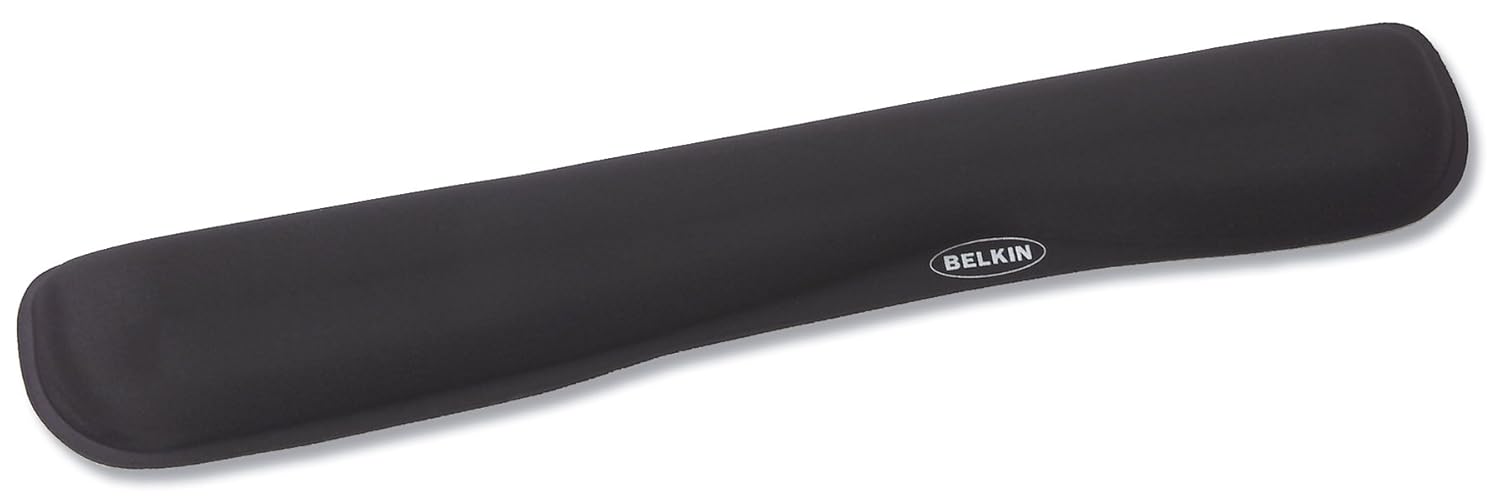
  • Do not rest your wrist on the keyboard unless you have a wrist cushion for your keyboard. 
  • Practice wrist-floating-style of typing and keep your arms in a neutral position- elbow bent comfortably by your side with wrist 1-2 inches below your elbows.


Wrist Cushion


  • When typing, use a light touch on the keys.

"The tendons from your fingers connect near your elbow so striking the keys too hard can lead to problems you might not associate with your keyboard like pain and inflammation in your elbows (Epicondylitis)." (Healthy Computing)


Now that you are comfortable in your chair, type away my friends!

Note: If you are more of a pen and pencil kind of writer, be sure to use a light grip. Let your ink flow as do your thoughts.

I hope this topic was helpful to you as it was for me. 

Wishing you all a healthy body and a creative mind!

****************
Here is a summary of the resources I've used:
Ergonomic Consultation:
http://ergovera.com/

Products:
http://somaergo.com/
http://www.askergoworks.com/
http://www.evoluent.com/vm4r.htm

Ergonomic Information:
http://www.healthycomputing.com/office/setup/keyboard/
http://www.livestrong.com/article/287638-pros-cons-of-sitting-on-a-stability-ball/
http://www.lni.wa.gov/IPUB/417-133-000.pdf


Monday, April 21, 2014

NONFICTION PICTURE BOOKS: Creative Nonfiction. Informational Fiction. Faction. WHAT'S THE DIFFERENCE?

I wrote a couple of nonfiction articles for magazines, but now I am interested in writing nonfiction for picture books. Nonfiction picture books must have three components:

  1. Visually appealing with attractive design and layout in a 32-page book
  2. Accurate information
  3. Engaging writing

Nonfiction picture books are written to attract the interest of young readers and get them excited about nonfiction. Sharon Ruth Gill of Reading Rockets explores this genre that is making waves in the publishing industry in her article, What Teachers Need to Know About the "New" Nonfiction.

Like picture books, nonfiction books for the younger reader must stand out in today's market. How do you do that?

GET CREATIVE!

But how much creativeness can you add to a nonfiction? This is where it gets sticky.

Myth: For my nonfiction to stand out, I should embellish it with interesting and fun details by weaving in a creative, made-up story.

*Truth: Once you add fiction, your story is fiction. Lee Gutkind of creativenonfiction.org says it best. Creative nonfiction is “accurate prose about real people and events written in a compelling, vivid, dramatic manner- true stories well told.”


Myth: If I write a story with a good plot, realistic characters and interesting facts, then I would have a great creative nonfiction.

*Truth: This all depends on what your realistic characters are saying and doing. Jan Fields of the Institute of Children’s literature writes, “Creative nonfiction happens when an author uses totally well researched facts to create a story-like narrative with no made up parts.” What you may have written is faction- blending of fact and fiction.


Myth: If I write a story about a father on an adventure through the woods with his daughter and informing her of facts about redwood trees along the way, that would make a great Creative nonfiction.

*Truth: When you have a made-up story with characters spewing out facts, or a blending of fiction with facts, then you have informational fiction- Facts in a fictional framework.

 ****

What about historical fiction? 
Many historical fiction are realistic. Characters may be fictitious, but the events and scenes are based on facts. Historical fiction is also described as a fictional account of real events or real people. Sherry Garland, children's author, talks about this and was surprised when some of her historical picture books won nonfiction awards.  


Historical fiction: Informational fiction, creative nonfiction, or faction? You will find the answer to this question on Sherry's blog, Into the Woods We Go.


What is faction? 
According to Gotham teacher, Brandi Reissenweber, faction is a blending of fact and fiction.  Author Sandra Markle defines it as "a fictional story in which all of the characters and the details are based on real facts."

Is faction creative nonfiction or informational fiction? Based on the definition above, faction sounds like information fiction to me. 

Sandra Markle, author of What if I Had Animal Teeth, classifies her books as faction. When I looked them up (What If I Had Animal Teeth, Animal Scavengers: Wolverines, and Hip-Pocket Papa) at my library, they were shelved in the nonfiction section. So faction, in this example, is creative nonfiction.


There were a few books on the 2012 Cybills nominee list for NONFICTION picture books that were categorized as FICTION at libraries: A Leaf Can Be by Laura Purdie Salas and Just Ducks by Nicola Davies, just to name a few.


This just proves how difficult it can be to distinguish creative nonfiction from informational fiction or faction. Are you as confused as I am? This topic is enough to make my head spin!

*****
Here are some examples of creative nonfiction books given by:
I.N.K. Creative Nonfiction for Kids
Sandra Markle's Nonfiction Books

NOTE: Some of the picture books listed on the blog, I.N.K. are listed as creative nonfiction, but when I looked them up at my library, there were a few that were categorized as fiction such as Move! By Steve Jenkins, Swirl by Swirl by Joyce Sidman, and Over and Under the Snow by Melissa Stewart.


 TIP: If you can't decide whether a picture book is creative nonfiction or fiction, check out the library and search for the title. If it is listed as a PB** then it is fiction. If it is listed as J###### then it is nonfiction. Study them and see if you can figure out for yourself why it is classified the way it is.

****
CREATIVE NONFICTION- accurate prose about real people and events written in a compelling, vivid, dramatic manner

INFORMATIONAL FICTION- facts in a fictional framework

FACTION- blending of fact and fiction

Below are some great resources that go into detail:


*****
Do you have a great resource to share that will demystify what faction is, please share!


Thursday, June 20, 2013

Like It. Love It. Gotta Have It!


"I like the premise of your book."
"I like your voice."
"I like your writing style."

LIKE. LIKE. LIKE.

I used to relish these words. It gave me validation as a writer. But the more feedback I get for my writing, the more I am realizing that liking it doesn't make it in this world. Think of the ways you can say, "I like it."

  • The well-meaning: With eye brows raised, a smile and a purposeful voice, "I like it!"
  • The hesitant: With head tilted to one side, nodding with a half smile, "I like it."
  • The liar: With no eye-contact and a hurried voice, "I like it."
  • The accomplice: With someone shaking his head violently at you and waving both hands in the air like he's wiping windows, you say to the person in front of him, "I like it?"
"I like it" could mean many things. A trip to my favorite ice cream parlor, Cold Stone Creamery, put it in perspective for me.


Like it = small cup
Love it = medium cup
Gotta have it = large cup

LIKE IT just doesn't compete with the larger sizes. 

Lately, I've been getting too many likes. And I'm not talking about Facebook. In this competitive picture book market, my manuscript needs to be loved. It needs to stand out. 


www.romellebroas.blogspot.com
Image courtesy of jscreationszs/ FreeDigitalPhotos.net

Now when I get a critique for my story, I am looking for the "I love it" comments. That's when I know that I am getting closer to a submission-ready manuscript.

I want to write something readers will love and I want editors and publishers to tell me they've GOTTA HAVE IT.

Now if you'll excuse me, I will drown my sorrows in some comfort food- ice cream!

Tell me your favorite Cold Stone ice cream flavor for a chance to win a Cold Stone gift card. Deadline to enter is June 29- my husband's birthday! (Drown your sorrows with me or celebrate with him) 

One winner will be chosen by Randomizer.com and announced by July 4th!

[Disclaimer: Don't get me wrong, "I like it" is a very good comment. I am setting high-standards for myself.]


Strive for the LOVE! 

 7/3/13 UPDATE:  Congratulations to SUSAN CABAEL! She won a gift card to Cold Stone.


LinkWithin

Related Posts Plugin for WordPress, Blogger...