There's been a surge for the use of mentor text in classrooms by students and teachers, and by writers. A few months ago Carrie Charlie Brown hosted an event that she created- Reading For Research Month (ReFoReMo) to help writers improve their craft.
I have to admit I've never really understood HOW to use mentor texts until I participated in ReFoReMo. If you'd like to learn about my methods of research, you can read about it on Carrie's blog.
In this interview, Donna will share her publishing journey with us, which started with a Pitch Party on Twitter that resulted in an unexpected
surprise.
After the interview, I've included a resource of small presses you may be interested in, along with some helpful information to help you decide whether small presses are for you.
You don't want to miss this! So sit back, relax, and get inspired
with Donna!
Tell
me about your book and the inspiration for your story idea.
My debut picture book, THE STORY CATCHER, is about a
little girl's struggle to make the wiggly words of her favorite book sit still
long enough for her to be able to catch them and read a story. I tutored
a young girl a few years ago who had a learning disability and was unable to
read on her grade level. After working with her for the entire school year, she
was finally able to read on her own. That experience of a child struggling with
a learning disability was the basis of this story.
Do
you have an agent? If not, what made you decide to submit on your own?
No, I don't have an agent at this time but I am
looking for one. After two years of searching for one, I found out about a
Twitter Pitch Party where picture book manuscripts were allowed and just took a
chance. It was supposed to be mainly agents so I really didn't think about an
editor requesting my book.
How
did you learn of Anaiah Press and what drew you to them?
I had never heard of Anaiah Press before the pitch
party. I decided to go with them because I was so impressed with my editor,
Jessica Schmeidler. She had an open communication style that matched mine and I
could tell she was really passionate about her author's works. I knew I could
trust her with the future of my story.
What
benefits do you see publishing with a small press?
Small presses with small catalog lines might have
easier submission guidelines and be more willing to take on an untried writer.
Small presses have smaller staff numbers so authors have a better chance of
connecting with high level individuals who are responsible for the decision
making.
Does
Anaiah help with the marketing of your book?
Anaiah offers a number of marketing support to their
authors including blog posts, book cover reveals, book trailers, and blog
tours.
What
have you done to promote your book?
Book marks, business cards, car magnets, school
visits, author visits to Barnes & Noble, contests and giveaways, blog
tours, book reviews, book submissions to book awards, book submissions to my
local library acquisitions committee, future participation in my city's annual
Children's Festival of Reading where up to 15,000 people will be able to sign
up for my STORY CATCHER FAN CLUB.
What
are you working on now? Any new stories in the works?
Currently I have 11 completed picture books, 2
completed early reader chapter books (one martial arts based fiction and one
creative nonfiction), and two young adult works in progress (one mystery and
one fantasy), along with research on my next creative nonfiction story.
Fun Facts
When did you
write the first draft of STORY CATCHER: 2013
Number of
months before you felt STORY CATCHER was submission-ready: 6 months
How many
months was it from the time of submission to acceptance with Anaiah Press: 1
day
Number of
months from the time of contract to publication with Anaiah Press: 11
months
The number
of publishing houses you submitted to prior to your contract with Anaiah Press:
ZERO
Thank you so much for sharing your journey with us Donna! For more on THE STORY CATCHER, check out this fabulous video:
Donna would love to hear from you! Check out
her Facebook fan page, drop her an email, join her STORY CATCHER fan club or
find out what interests Donna on Twitter or Pinterest:
Robert
Brewer of Writer's Digest goes into detail with a three-part assessment:
Submissions Process, Publishing Process, and Career Building. He interviews
authors about their experiences working with small presses and with publishers
about what they expect from authors and what they offer.
Agent Rachelle
Gardner of Books and Such Literary
Agency invites guest blogger and author, Jessica Knauss, to discuss the
pros and cons of small presses. Jessica's post is based on her personal
experiences and gets to the meat of the topic with bullet points, which makes
it a quick and easy read.
Literary Agent,
Carly Watters gives us her personal opinion on the disadvantages of seeking an
agent and a publisher simultaneously with a focus on small presses.
For a list of small publishers, check out my personal link here.
If there are any small publishers you've had experiences with, have submitted to, or know of that I've missed on my list, please share them with me in the comments below. Thank you!
It's been a while since I've posted on my blog. It's because I've been burying myself in nonfiction picture books!
I blame Kristen Fulton's wonderful nonfiction picture book writing class, Nonfiction Archaeology, for my fixation. I am familiar with writing nonfiction for magazines, but writing nonfiction picture books is a different animal for me. To help me get into the zone, I've immersed myself in nonfiction picture books. Below are few of my favorite (recent) reads that I am using as mentor text.
What I find challenging is writing for my target population. It's so easy to want to present all the facts that sometimes I get carried away with words. To make sure I stay on track, I found a wonderful site that helps me assess my work-in-progress: http://www.readability-score.com
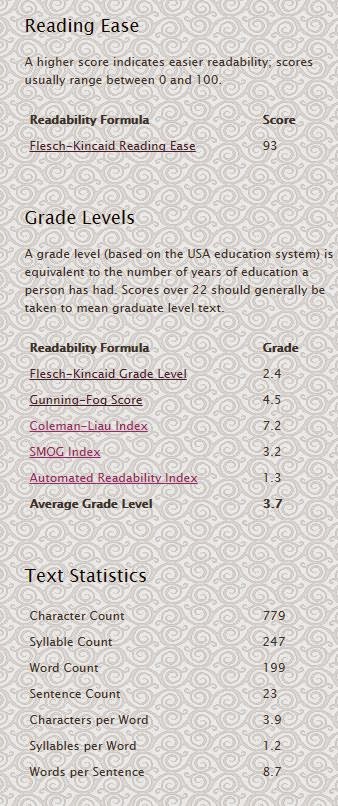
What you do is copy and paste your completed text in the box and hit enter on your keyboard. The site will analyze your story and give you the following information:
What's useful about this information is that you will know if your writing is targeted to the population you intended to write for.
The Flesch-Kincaid Reading Ease tells you the difficulty of your text:
90.0-100.0 Easily understood by an average 11-year-old student
60.0 - 70.0 Easily understood by an average 13-15-year-old student
0.0 - 30.0 Easily understood by a university student
Grade Level or Readability Formula Score: There is a mathematical way to determine these scores. You don't have to get caught up with each of these. All you need to know is the average grade level of the student your text is appropriate for.
Text Statistics is always fun, but the most useful is word count and words per sentence. As a writer, you want to make sure you vary your sentence length and keep within the word count that is suggested on submission guidelines.
Here are a few more sites I found helpful for studying mentor text:
Enter title of the book you want to study and hit "Go!"
Select the correct title displayed
I apologize for the small and blurry screen shot
To help you decipher the codes, here is a cheat sheet:
Interest Level (IL): This indicates the grade level the book is appropriate for, based on book content (theme, character, plot). Lower Grade indicates grade level K-3, Middle grade: 4-8, and upper grade: 9-12.
Book Level (BL): This represents the difficulty of the text. It means the text could be read independently by a student whose reading skills are at the grade level indicated.
AR Points (Accelerated Reader Points): This is based on the difficulty and length of the book. A point value system measures how much reading practice your child is getting. Not important, but thought you'd want to know.
The difference between the Renaissance Learning site and the AR Book Finder is that the AR Book Finder includes a rating of the book, judged by students based on enjoyment. It also includes a topic-subtopic, which is useful to know if you want to know how the book is sorted or categorized.
Enrolling in these classes kept me writing by helping me get into a routine. I was forced learned to manage my time. I didn't need to diet to squeeze my writing into my summer. All I had to do was loosen up the strings. I made time to write. I wrote whenever and wherever I could. It was the prescription I needed to keep my writing active and healthy.
Here is my review of each of the classes I've taken this summer:
From Storyteller to Exquisite Writer: The Pleasures and Craft of Poetic Techniques
This 5-week course is packed with information. It is perfect for beginner and seasoned writers. The course covered the basics of writing picture books and focused on rhyming and poetic techniques to make your story sing. The weekly webinars are perfect for questions and answers about writing in general. Mira also has a wonderful segment called Mondays with Mira in which she shares with you her favorite picture books and explains what makes it a great book. Included in the course are generous bonus materials which was a course in itself.
The most valuable is the one-hour critique session you get from Mira and Sudipta. The critique groups formed within the class is optional, but I highly recommend it.
http://www.childrensbookacademy.com/
The online class costs a bit. If you don't have the funds, Mira has been generous in offering scholarships for her classes.
If you aren't able to enroll in the class, here are a few resources I highly recommend:
Sudipta Bardhan-Quallen and Kami Kinard are a dynamic duo! They put together a blog-based, four week writer's workshop that runs during the months of July and August. The daily blog posts are filled with writing advice and information on improving your craft that is written by various authors and writing professionals. Their faculty includes award-winning PB, MG, and YA authors.
http://nerdychickswrite.wordpress.com/
Their summer session will motivate you. Each day you are given homework that will inspire your own writing. This summer's focus was on character development, which I found to be extremely helpful. They also offer weekly webinars where Sudipta, Kami, and other guests answer your burning questions about the craft of writing.
I have to confess that I could not keep up with the homework and ended up dropping out mid-way. Okay, I admit it. I am a summer school drop out. Shhhh....don't tell. Nevertheless, it is a worthwhile session and I enjoyed the camaraderie of the summer school group. It's just that half-way through, I was inspired to take a nonfiction class which I will review below.
The best part of Kidlit Summer School? It's FREE! It can't get any better than that.
Nonfiction Archaeology
This is a four week class that is offered monthly by author, Kristen Fulton. She hosts a weekly webiner and daily blog post. This class is still going on. I am three weeks into the class and have gained a wealth of information. I have to say that I am loving this class so much! I am in awe of Kristen's intelligence, writing, passion, and organization skills. I want to be her!
http://www.kristenfulton.org/classes.html
The class is so organized in that the lessons are introduced in a sequential manner in which you would write a nonfiction picture book from beginning to end. So as you are taking the class, your are already on your way to writing and completing a nonfiction story. In the webinar, Kristen discusses the lessons for the week and the blog posts that follows reinforces everything that she's covered. I can't say enough about this course.
If you are thinking of writing a nonfiction picture book, I highly recommend Kristen's class. It is worth more than the price you pay for her class. Kristen is so generous in sharing her wealth of information and has gone over and beyond what I expected.
*******
So there you have it. If you need to ignite your writing, consider taking a class or participating in a challenge offered by generous writers. Don't worry about squeezing writing into your summer. Make the summer fit into your writing!
"Writing is like a vacation. I get to travel anywhere my imagination takes me" ~Romelle
Here's a scenario: Agent: Hi wonderful writer, this is so-n-so from Blank Agency. Wonderful writer: Who? Agent: So-n-so from Blank Agency. You sent me a couple of your manuscripts in hopes of seeking representation. Wonderful writer: OH! Yes, now I remember. Agent: I'm calling to let you know that I see a lot of promise from you and I'd like to represent you. Are you interested? Wonderful writer: Ahhhhhhh!!!! EEEEeeeee!!! Woooooootttttt! Agent: I take that as a yes? Now do you have any questions for me? Wonderful writer: Uhhhhh.....Ummmm...Thinking. Thinking. Thinking. Can I get back to you?
Don't let this be you!
I haven't had the opportunity to be in a situation like this, but I thought it would be important to prepare myself to avoid the awkwardness. By being prepared with what to expect and asking smart questions, it'll make your conversation with your agent a smooth one. I've collected some helpful links for your convenience. I've summarized the posts and organized them in order of use for easy reference.
What to do when the agent calls you- before the call, during the call, after the call
Before the Call What to Ask Literary Agent When You Get the Call by Casey McCormick Casey of Literary Rambles gives some sound advice on being prepared. She shares a list of questions found on other sites that she's created for herself. This is an exhaustive list from which you can pick and choose the ones that work for you. Of course, it's best to study your agents before hand. You should have some knowledge as to how your agents works. This will help you reduce your questions to the most important ones. Questions to Ask an Agent by Kathy Temean Kathy shares the top 10 questions that agent Linda P. Epstein of Jennifer De Chiara Literary Agency deems as the most thoughtful questions she's been asked by her client Lesley Cheah and others. If you don't want to go through an exhaustive list, then this list is for you.
During the Call Taking a Call...The Call by Heather Ayris Burnell Heather, Creator of the Sub-It-Club, gives advice on how to respond to an offer for representation. In other words, how to tactfully tell an agent that you need time to think about it or to notify other agents who have your manuscripts. After the Call Handling Outstanding Queries When an Agent Offers Representation by Lisha Cauthen What about the other agents whom you've never heard back from? Lisha of Sub-It-Club has a checklist made out to help us handle a situation like this. She also includes a sample letter that you can send to the agents who are still holding on to your manuscripts.
You Have an Agent Now What The Agent/Client Contract by Mira Reisberg Agent Mira Reisberg of Hummingbird Literary Agency addresses some of the important aspects that are listed in an agent/client contract. Now That The Dust Has Settled How to Fire Your Agent by Jenny Bent This is something we hope we don't have to do, but it can happen. Jenny goes over some points to consider before we make the decision to fire an agent. She also shares some tips on how to go about firing an agent with dos and don'ts and includes other helpful links So there you have it. I suggest going through the links in this order. Prepare your questions for the agent who calls, have a letter to other agents ready to go, and practice your happy dance!
Image courtesy of Grant Cochrane / FreeDigitalPhotos.net
I had the opportunity to attend a class by registered nurse,
Deidre Rogers of Ergovera.com in ergonomics last week. The lessons I learned
helped me be more aware of my posture.
As writers, we spend a lot of time in front of the computer
so I thought the ergonomics of the writer would be a valuable topic to share
with all of you.
Here is a summary of what I learned:
DESK
Most desks are made to fit men. This means the average
height of a desk is 27 inches from floor to elbow. It's advisable to use an adjustable desk that you can
elevate or lower according to your position/size.
A keyboard tray is most useful since it will likely place your keyboard at the level of your neutral elbow/wrist positions. Your elbow must rest comfortably at your side with wrist 1-2 inches below your elbows when typing.
It is helpful to purchase an adjustable desk which can be raised or lowered to fit your needs, especially if multiple people are using one desk.
CHAIR
A chair with a convex back supports the back better. SomaErgo.com and Ask Ergo Worksoffers a wide range of modular chair systems which you can adjust to fit your body.
The arm rest of a chair must be in a neutral position. Again, find a chair that is not too wide. Your arms should fall naturally on the arm rest without you having to spread your arms wider than your shoulder width.
When sitting, your back, head, and neck should be in a neutral position. To help you with this, visualize your head as a bowling ball balancing on your neck/spine. Your head too forward or back can cause strain on your neck and shoulders.
Your hips should be 1-2 inches above the knee. Your back should be supported. Women tend to sit straight, perched on their seats. Make use of your backrest. That's what it's for.
If you use a gym ball, again make sure your hip bone is 1-2
inches above your knee height. Deidre Rogers, RN advises using gym balls to no
more than 20 minutes at a time and 3 times a day at maximum.
Note: While the gym ball helps engage core abdominal muscles, improves stability, and strengthens lower back, the absence of an arm and back rest can cause neck and shoulder strain. The gym ball also may not be tall enough for your desk putting your wrist and elbow in a compromised position.
COMPUTER SCREEN
Your eyes lead your posture. The top line of your text on
the screen should be 2 inches lower than your line of sight. In other words,
your eye sight should be looking at a 15 degree angle downward towards the top
line of your text.
When sitting at the screen for long periods of time, the computer glare can be straining on the eye. Give your eyes a rest and follow THE RULE OF 20.
After 20 minutes of viewing, look 20 feet away for 20 seconds.
The body also needs to refresh itself. After 20 minutes sitting in front of the computer, loosen your limbs, stretch, or take a walk.
KEYBOARD AND MOUSE
If you are small-boned like me, the smaller your carpal tunnel bone is. This can lead to poor circulation and cold hands. So in small-boned people, it is important to be mindful of your posture to prevent future problems that can lead to carpal tunnel syndrome.
Carpal Tunnel Syndrome- "A disorder that causes numbness in the hand and pain in the wrist due to the compression of the median nerve, which runs down the arm to the fingers."
Your wrist should be straight and in line with the rest of your arm.
With your fingers on the keyboard, your elbow should be slightly above your wrist at an almost 120-degree angle.
Here is a photo of an ergonomic keyboard that positions your wrist and arms in a neutral position. Notice the angle of the keyboard.
Your keyboard length shouldn't be wider than your shoulders. Otherwise, the reach of your mouse will be unnatural.
People with broad chests will benefit with the split keyboard design.
The use of your mouse can develop a thumb disorder calledDe Quervain disorder.
De Quervain's tenosynovitis (dih-kwer-VAINS ten-oh-sine-oh-VIE-tis)- "is a painful condition affecting the tendons on the thumb side of your wrist. If you have de Quervain's tenosynovitis, it will probably hurt every time you turn your wrist, grasp anything or make a fist." (Mayo Clinic)
Note: A mouse that will position your hand and wrist in a neutral position to reduce your wrist of developing De Quervain disorder will look like this:
Your mouse should be placed at the level of your keyboard and close to it so you don't have to reach for it. Reaching can cause problems to your rotator cuff.
Shortcut keys eliminate mouse use. Deidre advises you use shortcut keys as much as possible. It's best to use two hands when using a shortcut key combination to avoid straining either hand with awkward finger and wrist positioning. Here is a list of Shortcut keys.
TYPING
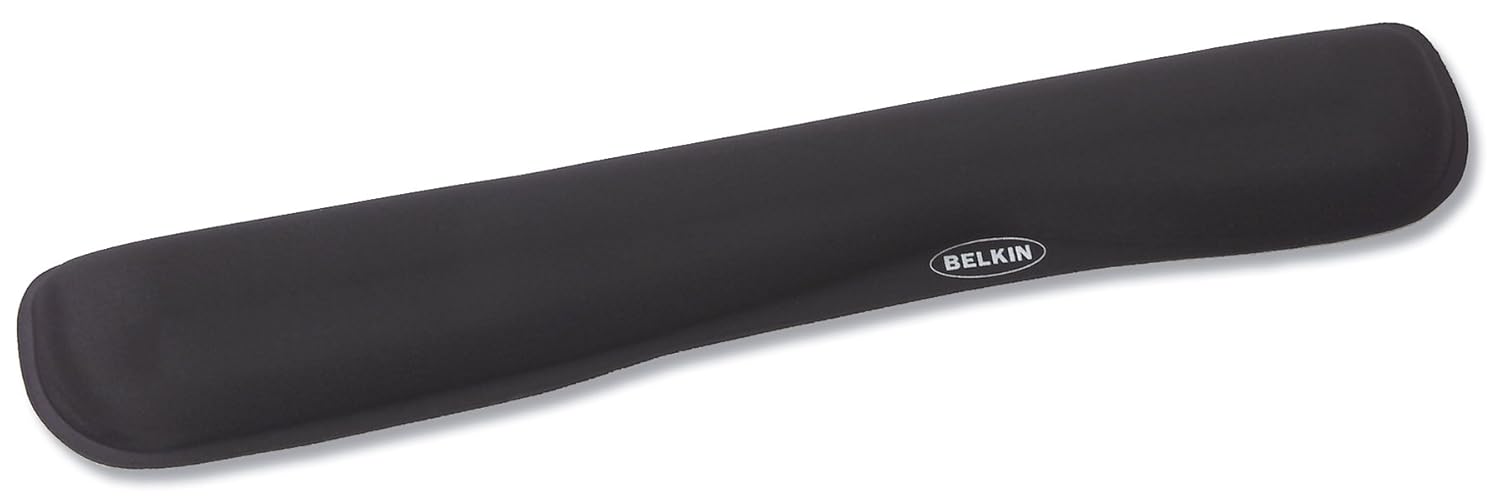
Do not rest your wrist on the keyboard unless you have a wrist cushion for your keyboard.
Practice wrist-floating-style of typing and keep your arms in a neutral position- elbow bent comfortably by your side with wrist 1-2 inches below your elbows.
Wrist Cushion
When typing, use a light touch on the keys.
"The tendons from your fingers connect near your elbow so striking the keys too hard can lead to problems you might not associate with your keyboard like pain and inflammation in your elbows (Epicondylitis)." (Healthy Computing)
Now that you are comfortable in your chair, type away my friends!
Note: If you are more of a pen and pencil kind of writer, be sure to use a light grip. Let your ink flow as do your thoughts.
I hope this topic was helpful to you as it was for me.
Wishing you all a healthy body and a creative mind!
****************
Here is a summary of the resources I've used: Ergonomic Consultation: http://ergovera.com/ Products: http://somaergo.com/ http://www.askergoworks.com/ http://www.evoluent.com/vm4r.htm Ergonomic Information: http://www.healthycomputing.com/office/setup/keyboard/ http://www.livestrong.com/article/287638-pros-cons-of-sitting-on-a-stability-ball/ http://www.lni.wa.gov/IPUB/417-133-000.pdf


.jpg "http://donasdays.blogspot.com/p/story-catcher-fan-club.html")