Showing posts with label writing tips. Show all posts

Wednesday, April 30, 2014

ERGONOMICS AND THE WRITER

I had the opportunity to attend a class by registered nurse, Deidre Rogers of Ergovera.com in ergonomics last week. The lessons I learned helped me be more aware of my posture.

As writers, we spend a lot of time in front of the computer so I thought the ergonomics of the writer would be a valuable topic to share with all of you.

Here is a summary of what I learned:

DESK

  • Most desks are made to fit men. This means the average height of a desk is 27 inches from floor to elbow. It's advisable to use an adjustable desk that you can elevate or lower according to your position/size.
  • A keyboard tray is most useful since it will likely place your keyboard at the level of your neutral elbow/wrist positions. Your elbow must rest comfortably at your side with wrist 1-2 inches below your elbows when typing.
  • It is helpful to purchase an adjustable desk which can be raised or lowered to fit your needs, especially if multiple people are using one desk.

CHAIR

  • A chair with a convex back supports the back better. SomaErgo.com and Ask Ergo Works offers a wide range of modular chair systems which you can adjust to fit your body. 
  • The arm rest of a chair must be in a neutral position. Again, find a chair that is not too wide. Your arms should fall naturally on the arm rest without you having to spread your arms wider than your shoulder width.


  • When sitting, your back, head, and neck should be in a neutral position.  To help you with this, visualize your head as a bowling ball balancing on your neck/spine. Your head too forward or back can cause strain on your neck and shoulders.
  • Your hips should be 1-2 inches above the knee. Your back should be supported. Women tend to sit straight, perched on their seats. Make use of your backrest. That's what it's for.
  • If you use a gym ball, again make sure your hip bone is 1-2 inches above your knee height. Deidre Rogers, RN advises using gym balls to no more than 20 minutes at a time and 3 times a day at maximum.

Note: While the gym ball helps engage core abdominal muscles, improves stability, and strengthens lower back, the  absence of an arm and back rest can cause neck and shoulder strain. The gym ball  also may not be tall enough for your desk putting your wrist and elbow in a compromised position.


COMPUTER SCREEN

  • Your eyes lead your posture. The top line of your text on the screen should be 2 inches lower than your line of sight. In other words, your eye sight should be looking at a 15 degree angle downward towards the top line of your text.
  • When sitting at the screen for long periods of time, the computer glare can be straining on the eye. Give your eyes a rest and follow THE RULE OF 20.
    • After 20 minutes of viewing, look 20 feet away for 20 seconds.
    • The body also needs to refresh itself. After 20 minutes sitting in front of the computer, loosen your limbs, stretch, or take a walk.

KEYBOARD AND MOUSE

  • If you are small-boned like me, the smaller your carpal tunnel bone is. This can lead to poor circulation and cold hands. So in small-boned people, it is important to be mindful of your posture to prevent future problems that can lead to carpal tunnel syndrome.
  1. Carpal Tunnel Syndrome- "A disorder that causes numbness in the hand and pain in the wrist due to the compression of the median nerve, which runs down the arm to the fingers."


  • Your wrist should be straight and in line with the rest of your arm.
  • With your fingers on the keyboard, your elbow should be slightly above your wrist at an almost 120-degree angle.


Here is a photo of an ergonomic keyboard that positions your wrist and arms in a neutral position. Notice the angle of the keyboard.
Available at Ask Ergo Works


  • Your keyboard length shouldn't be wider than your shoulders. Otherwise, the reach of your mouse will be unnatural.
  • People with broad chests will benefit with the split keyboard design.
  • The use of your mouse can develop a thumb disorder called De Quervain disorder.

De Quervain's tenosynovitis (dih-kwer-VAINS ten-oh-sine-oh-VIE-tis)- "is a painful condition affecting the tendons on the thumb side of your wrist. If you have de Quervain's tenosynovitis, it will probably hurt every time you turn your wrist, grasp anything or make a fist." (Mayo Clinic)


Note: A mouse that will position your hand and wrist in a neutral position to reduce your wrist of developing De Quervain disorder will look like this:

Evloluent mouse available at Evoluent.com 
  • Your mouse should be placed at the level of your keyboard and close to it so you don't have to reach for it. Reaching can cause problems to your rotator cuff.
  • Shortcut keys eliminate mouse use. Deidre advises you use shortcut keys as much as possible.  It's best to use two hands when using a shortcut key combination to avoid straining either hand with awkward finger and wrist positioning. Here is a list of Shortcut keys.


TYPING

  • Do not rest your wrist on the keyboard unless you have a wrist cushion for your keyboard. 
  • Practice wrist-floating-style of typing and keep your arms in a neutral position- elbow bent comfortably by your side with wrist 1-2 inches below your elbows.
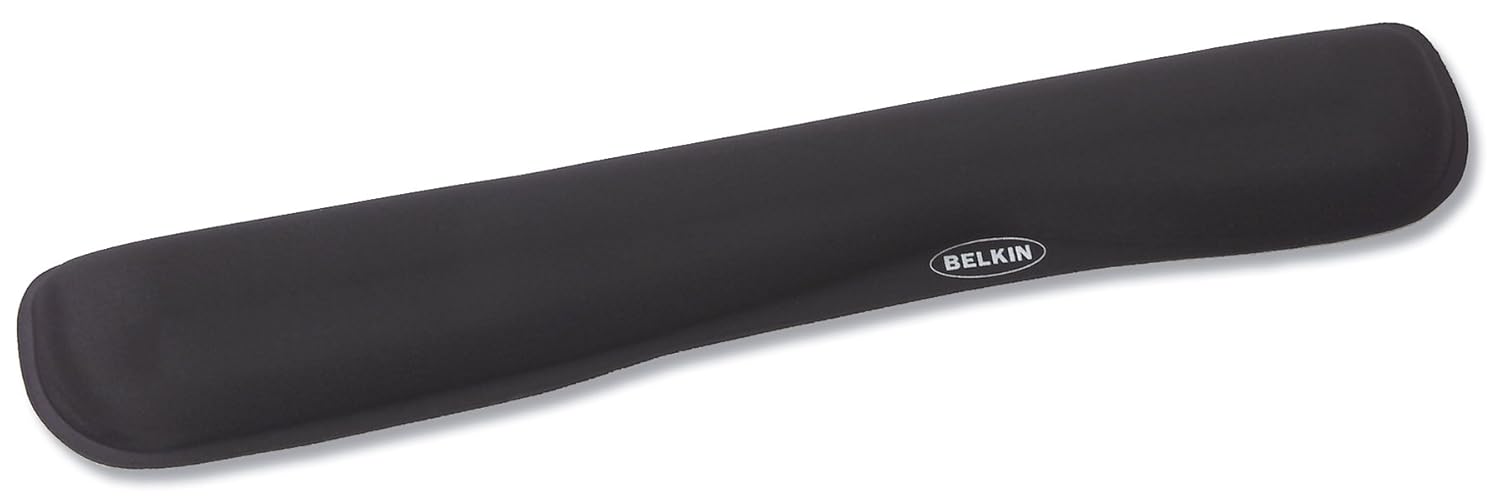

Wrist Cushion


  • When typing, use a light touch on the keys.

"The tendons from your fingers connect near your elbow so striking the keys too hard can lead to problems you might not associate with your keyboard like pain and inflammation in your elbows (Epicondylitis)." (Healthy Computing)


Now that you are comfortable in your chair, type away my friends!

Note: If you are more of a pen and pencil kind of writer, be sure to use a light grip. Let your ink flow as do your thoughts.

I hope this topic was helpful to you as it was for me. 

Wishing you all a healthy body and a creative mind!

****************
Here is a summary of the resources I've used:
Ergonomic Consultation:
http://ergovera.com/

Products:
http://somaergo.com/
http://www.askergoworks.com/
http://www.evoluent.com/vm4r.htm

Ergonomic Information:
http://www.healthycomputing.com/office/setup/keyboard/
http://www.livestrong.com/article/287638-pros-cons-of-sitting-on-a-stability-ball/
http://www.lni.wa.gov/IPUB/417-133-000.pdf


Wednesday, August 28, 2013

SCBWI LA Reflections, Part 3- Buzz Words, Quotes, Key Points, and What Agents are Looking for!

My vocabulary list has grown since the SCBWI conference in LA. I thought I'd share it with you since you'll probably be hearing a lot of these words in the industry. 

SUBVERSIVE- Keynote speaker Jon Sciezka, author of Cowboy & Octopus, The True Story of the Three Little Pigs, and Stinky Cheese Man, talked about stories that broke all the rules. His picture books are perfect examples of these. 


www.romellebroas.blogspot.com


"We have a bold tradition of being experimental in our books because we have the most bold and experimental readers." ~Mac Barnett

PALIMPSEST- Kirby Larson, author of Whispers of the Past, talked about ideas and how many of them are reused to make something new.

METAFICTION- Mac Barnett, author of Extra Yarn, talked about writing a book with new rules.  He defines metafiction as "a book that talks about it being a book." like his own Chloe and the Lion.

TRANSMEDIA- Julie Hedlund and Sarah Towle talked about publishing across multiple formats (print, digital, and film) and how a story is reworked and adapted to each form resulting in the creation of a story world. A good example of this is The Fantastic Flying Books by Moriss Lessmore

GENRE BREAKERS- Julie Hedlund, author of A Group is a Troop of Monkeys and A Shiver of Sharks, mentions that books in app form offers possibilities for subversive stories or genre breakers, which is the crossing over of two or more styles- think mash-up of genres.


Key Points
The SCBWI conference in LA was loaded with fabulous workshops. Here are 2 of my favorite speakers and the message that resonated with me.

From Richard Peck, award-winning author:  You are Only as Good as Your Opening Line- Find something that interest your reader and put it in your first line.

From Andrea Pinkney, V.P., Executive Editor at Scholastics and award-winning author: Think about your unique talent. Explore new genres. Find your twinkle! There could be more interesting stories that may or may not come out of you if you hadn't explored other topics or genre.

"To live a creative life, we must lose our fear of being wrong" ~Joseph Chilton Pierce


What agents are seeking
Now, what you've all been waiting for! There is a consensus among agents and editors as to what manuscripts they are seeking. Here is their list:
  • a story that they connect strongly enough on a personal level
  • a story that they feel passionate about
  • a sorry that touches the emotional core
  • a story with a great concept and great writing!


Sorry to disappoint you, but that's all I've got out of them. The last bullet says it all.

Well that's it for my SCBWI LA reflections. There was a lot of sitting, listening, and note-taking. But as they say, work hard and play hard. Writers sure know how to party!

www.romellebroas.blogspot.com
The faces of these partiers have been disguised to protect their identity.

Overall, I had a blast! I am so glad I saved up for this event. The SCBWI is such a supportive and inspiring group. I am happy to be a children's writer.

If you missed my other SCBWI Reflections, here they are:
Part 1- Coming Home to Reality
Part 2- Goals and Statistics

Wednesday, July 24, 2013

Blog Hop- Writer's Tell All

Have you watched The Bachelor or Bachelorette reality dating show on ABC TV? Neither have I.  But one of my favorite segments I heard that the Bachelor/Bachelorette: Women/Men Tell All segment is the most interesting and entertaining part of the show. This is where secrets are told and discoveries are made. I just learned that Juan Pablo may be the next Bachelor (not that I follow the show or anything). 


In any case, I am presenting to you a Blog Hop: Writers Tell All!
Vivian Kirkfield of Picture Books Help Kids Soar tagged me in a Blog Hop. I am to answer three questions related to my writing and tag 3 others to do the same. I invite you to visit the other writers and enjoy the updates of their writerly life. Who knows, you may discover a secret or two. 

What I want to find out is who started this blog hop. So I did some investigating. Here's my blog hop tree:

Chart made on http://www.easel.ly/


[News flash: I just got tagged by Sylvia Liu too! She's not on the chart but she would be in the same circle as Vivian Kirkfield. Hmm...wonder what her Blog Hop tree would look like.]

Now that you know my Blog Hop tree, on to the interview!


Question 1: What are you working on?
  • Polishing 2 picture book manuscripts
  • Researching and submitting to a short list of agents
  • Writing a new picture book story for this month's 12 x 12 with Julie Hedlund
  • Critiquing my fellow writers' manuscripts (usually it's 7 in a month for my 3 groups)
  • Studying current picture books by visiting my local library every week
  • Participating in Pam Calvert's Picture Book University
  • Gearing up for next week's SCBWI conference in Los Angeles!

Question 2: How does your writing process work?
Here are the steps I use in my writing process:
  1. I work through my list of picture book ideas that I came up with during Tara Lazar's PiBoIdMo (Picture Book Idea Month) and write a draft of the story. Julie Hedlund's 12 picture books in 12 month challenge helps me keep focus.
  2. I revise until I feel my story is as good as it can be (this is my favorite step).
  3. I send it off to 1 of 3 critique groups I belong to. Having more than one critique group is beneficial because not all groups critique the same way. Critique group (CG) #1 focuses a lot on plot- what works and what doesn't work. They are critical thinkers who challenge me the most. CG #2 does a lot of line editing, which I appreciate so much. CG #3 is a little bit of both my CG #1 and #2 and tunes in to the marketability of a story. Eventually, my manuscripts make the rounds of all three groups after much revising.
  4. I get a feel from my critique groups to determine which of my manuscripts are worth pursuing and concentrate on polishing those.
  5. I send my polished manuscript through another round of critiques until it is submission-ready.
Question 3: Who are the authors you most admire?
Mo Willems! I admire his skill of writing humor in succinct text. His dialogue is so authentic to the child's voice. 
Margie Palatini I love her writing style- her rich language, dazzling word choice, and distinctive voice. 

Amy Krouse Rosenthal Her books are clever and fun!


Now it's my turn to tag 3 people (Actually I'm tagging 4 because I'm a rebel). Stop by their blog and join the fun. You may discover interesting tips or leads as Writers Tell All!

TAG YOU'RE IT!


Monday, February 11, 2013

Chameleons, Colors, and the Creative Muse

Most people believe that chameleons change color in response to their surroundings.  Instead, chameleons change color based on temperature, health, light intensity, and mood-- much like my main character in my eBook, Casey Chameleon.

www.romellebroas.blogspot.com
Available at Flying Books


"Casey thinks someone has stolen her special feather and she finds herself turning red with anger. Can she manage to turn green again? A story about learning to manage emotions. Young readers will identify with Casey's feelings and fall in love with her playfulness and determination."


While a chameleon's mood can affect its colors, the colors of our environment can affect people's moods. When we see a field of bright sunflowers, we feel livelier and happy. 


Sunflower
courtesy of sxc.hu


When we see grey clouds, we instinctively feel gloomy.

tree on hill
courtesy of sxc.hu

Artists use colors to evoke emotion, communicate mood, or enhance meaning. As writers, why not create an environment of colors that promote creativity?

Below is a list of colors and its effect it can have on us:  

RED stirs up excitement and stimulates our heart rate and breathing.  It can also stimulate conversation. Red is also known to spikes our attention and alertness. 

YELLOW is energizing and uplifting. It communicates happiness and can stimulate memory.  But too much yellow tend to create feelings of frustration and anger.

BLUE is calming, relaxing, and serene.  It can  promote imagination and intuitive thinking. Encourages exploration and boosts creativity. But dark blue can evoke feelings of sadness. 

GREEN also has a calming effect like blue. It encourages unwinding and promotes comfort and togetherness. It helps relieve stress and controls anxiety. 

PURPLE is associated with creativity and luxury. Lighter shades of purple have a restful quality.

ORANGE is an energizing color that evokes excitement and enthusiasm. It stimulates appetite and encourages conversation.

If you will excuse me, I'm going to paint my room with colors that inspire my creative muse- blue with purple stripes and a splash of yellow in preparation for my February picture book draft for 12 x 12 with Julie Hedlund!


My Creative Wall


What colors would you use on your wall?


--------------------------------------------------------------
References:
http://psychdigest.com/colors-influence-mood/
http://www.artyfactory.com/color_theory/color_theory_3.htm
http://tlc.howstuffworks.com/home/color-of-room-affect-mood.htm
http://www.vcstar.com/news/2013/feb/05/scientists-find-colors-can-affect-focus-and/
http://www.pbs.org/edens/madagascar/creature3.htm
http://www.nwf.org/Kids/Ranger-Rick/Animals/Amphibians-and-Reptiles/Chameleons.aspx


Tuesday, January 22, 2013

WRITER'S LANGUAGE- Deciphering the Code


I'm going to sub my PB MS with a WC of 450 to an OP

If you are a new writer wandering around the blogosphere of kidlit writers, some of the acronyms being spewed out may seem foreign to you.  I call it writer’s language.  

To help you get integrated into the "inner circle," I've compiled a translation guide.  Learning the terminology will help get you by so you won’t feel lost in a conversation.  The following is a list of common words used in the writing industry. 

MG:   middle grade novel (ages 8-12)
YA:    young adult (ages 12 & up)
MC:   main character
OP:    online publisher
WC:   word count
MS:    manuscript
MSS: manuscripts (plural)
PB:    picture book
WP or WIP: work in progress (thanks for the add, Erik!)
ARC: advance reader copies (looks very close to what the final version of a book will look like in final publication.  The term ARC can be used interchangeably with “galley” (an old-school publishing term)
Illo:    illustration notes
sub:   submit

How do you like my illo?  I drew it myself.  


Here are a few others you may want to know:
PiBoIdMo- Picture Book Idea Month, hosted by Tara Lazar.  During the month of November, participants write down a story idea a day for 30 days.

12x12- A challenge of writing 12 picture books in 12 months, hosted by Julie Hedlund.

NaPiBoWriWee- National picture book writing week, hosted by Paula Yoo.  A challenge in which writers write a picture book a day for seven days during the month of May.

RLGL- Red light, green light challenge by Cynthea Liu.  Challengers send in their first page of the manuscripts up to 125 words.  If you get a green light, you submit the next 125 and so on until you get a red light.  The winner is the person who ends up sending in their complete manuscript.

GUTGAA- Gearing up to get an agent challenge, hosted by Deanna Barnhart.  Writers send in their pitch to win an exclusive submission to an agent.


With this cheat sheet you, too, can sound like a "professional" writer.  Give it a try.

I'd better get going.  I want to polish my mss with 12x12.  Need to work on my MC.  Hoping to sub soon.

If you know of other words I may have missed, please share.  I'd love to add it to the list!

Tuesday, January 15, 2013

Debut Author Interviews- Learning From Those Who Have Succeeded

I just completed the last of my series of debut author interviews for 2012. I'd like to thank all the authors for sharing their journey with me.  

Sandra Feder, author of DAISY'S PERFECT WORD

Rob Sanders, author of COWBOY CHRISTMAS 
Nessa Morris, author of REACHING FOR RAINBOWS
Donna Earnhardt, author of BEING FRANK
Laura Murray, author of THE GINGERBREAD MAN LOOSE IN THE SCHOOL
Sherri Duskey Rinker, author of GOODNIGHT, GOODNIGHT CONSTRUCTION SITE
Amy Dixon, author of MARATHON MOUSE
Karin LeFranc, author of A QUEST FOR GOOD MANNERS

         Goodnight, Goodnight Construction SiteMarathon MouseCowboy ChristmasDaisy's Perfect WordBeing FrankA Quest for Good MannersReaching for RainbowsThe Gingerbread Man Loose in the School
"Be true to yourself and your own story.  Write from your heart and your passion." ~Sherri Duskey Rinker

Since we are starting a new year, I thought it would be good to summarize the valuable tips I learned from them. Each of the authors shared great advice, unique to their experience, but they all agreed on the following:  
  1. Join SCBWI and attend an SCBWI conference
  2. Read books on how to write for children and books in your genre
  3. Research the market, publishing houses, and its editors before submitting

Join and Attend an SCBWI Conference

One of the great things about joining SCBWI is the community of writers who are very supportive, and the writing resources that are available.  As Karin LeFranc puts it, "Attending an SCBWI conference a wonderful way to learn the business, meet other writers, and find out what editors and agents are looking for."

The biggest benefit in attending a SCBWI conference is that editors and agents will accept submissions from conference attendees.  This is a good opportunity to submit to publishers who may be closed to submission.  


Sandra Feder says a face-to-face contact is the best way to get someone interested in your work.  Take it from Rob Sanders.  He met his editor, Diane Muldrow of Golden Book/Random House, at an SCBWI conference in Los Angeles. Diane requested he send his manuscript to her then offered him a contract. Sandra and Rob both agree that the best place to meet agents and editors in person are at conferences.  


If you want to get that one-on-one meeting, Rob suggests signing up for a critique or consultation.  If you're lucky, you will be paired up with an agent or editor who may be interested in your work.

"You'll never get published if you don't submit."  ~Donna Earnhardt


Read Books on How to Write for Children and Books in your Genre


There are lots of helpful resources on writing for children at the library and online.  If you study your craft, you will stand out from the slush pile. But the best way to learn how to write for children is to know and understand the readers.  Reading to children helped Laura Murray understand what children liked, what they found funny, what was too long or too wordy, and more. That helped her with her book Gingerbread Man loose in the School.  


Research

Do not send out a mass submission to every publisher. Amy Dixon suggests recognizing the type of book you have and targeting your submission.  Study publishers before sending your manuscript to them. Research what genre they are publishing and the types of stories they are interested in.  Your manuscript will fare better if your manuscript fits the publisher's list. It worked for Sherri Duskey Rinker. Chronicle Books is the first and only publisher she submitted Goodnight, Goodnight Construction Site to. She did her research, narrowed her list to one publisher, and hit the bulls-eye!    

Amy Dixon did her research too and got lucky. It so happened that the editor Amy submitted to has 3 kids who run marathons.  Her PB, Marathon Mouse, found its way to the perfect person.

If you want to get a hands-on approach on learning about the publishing industry, you can self-publish as Nessa Morris did. "What better way to learn about the whole process than doing it yourself," says Nessa.

All of these authors shared a unique experience.  But they all possess these valuable traits:
  • Patience
  • Hard work
  • Persistence
Take it from Donna Earnhardt, "You'll never get published if you don't submit." Donna received many rejections before her picture book, Being Frank, got published.

I hope you all took away something from these group of talented authors.  They were once unpublished like you.  Never give up hope. You will have your chance.  2013 could be the year!  
 "Be free to fail. Open yourself up to critique, to rejection.  don't be ruled by fear." ~Amy Dixon
Keep on writing, my friends!   


Monday, July 30, 2012

RULES or no rules of RHYME


RHYME.  GRIME.  SLIME.  WORK TIME.  
This is what rhyme is to me.  This is my gripe session.  So please bear with me.  I hope I'm not the only one not getting it.

I’ve been told that editors seldom accept rhyming books unless it is well written.  Rhyming picture books must have a story with perfect rhythm and rhyme.  I always thought I was pretty good with rhyme, but the edits I get from my critique group tell me otherwise.  So, I avoid writing in rhyme because the term "perfect" intimidates me.  

I've read a few articles on how to write in rhyme.  I also embraced the suggestions I get from my critique group.  I even studied numerous rhyming picture books.  But after much researching, it still left me dumbfounded.  

Here is an example of a verse I read in a picture book.   I found quite a few words that were near rhymes, not perfect rhymes:

Baby's got some brand new shoes,
white as light, stripe of blue...

Baby likes to run so fast,
spin in circles on the grass.
After all those jumps and hops...
...sees what has green polka dots.

Shoe and blue rhyme, but not shoes and blue. Fast and grass, hops and dots are not perfect rhymes. I’ve been criticized for using these types of rhymes in my writing. But apparently in some cases, it is okay.

I've been told to count the beats (the stresses) and syllables in each measure.  There should be a pattern throughout the book. 

But I don't always find this to be true...or maybe it is and I am reading the passage the wrong way.  The tricky thing about rhyme is everyone reads differently and may place emphasis in different places of a word.  
I've also been criticized for not having equal amount of syllables per line throughout my story.  I honestly don't think it is necessary to have equal amount of syllables per line.  Is it?  I don't see it consistently in picture books.  The important thing are the number of beats per measure.  

Another rule of rhyme is to avoid the rearrangement of words to accommodate the rhyme.  You shouldn't use a word just for rhyme sake.  This often ends up in a speech that's unnatural.  Fortunately, I didn't see much of this in the books I've studied.  

So what does this tell me?
a)     Sometimes rules are meant to be broken
b)     If you are a well-known author or a previously published author, it’s okay
c)     If you write a really good story, sometimes other technical elements can slide
d)    I still don't understanding how to write in rhyme

Do you know of a great book or website that will teach me how to write great rhyme?  Please share them with me.    Here are a few resources I found helpful:

Writing Stories in Rhythm and Rhyme, by Dori Chaconas

The Meter Maids by Corey Rosen Schwartz & Tiffany Strelitz Haber

Debbie Diesen, Guest blogger, on Julie Hedlund's Write Up my Life

Rhymes and Misdemeanors by Hope Vestergaard

*********
Be sure to check back.  In my next debut picture book author interview, I have New York Time's #1 Bestseller, Sherri Duskey Rinker of GOODNIGHT, GOODNIGIHT, CONSTRUCTION SITE!  Discover how this debut author made it to #1...

Sunday, April 1, 2012

My Desk

I am a full-time dental hygienist, an athlete, and a mother of 2 busy young boys.  Having a chunk of time devoted to writing at my desk is rare.  So I find it helpful to utilize the time I do have.  For me, a few minutes of writing time is valuable.  I call these Gold Nuggets!  You can find them too. 

I thought it would be fun to share with you my Gold Nuggets.  I don't have to be at my desk in front of a computer creating stories.  As long as I have my notebook, I can write anywhere.  Unlike a laptop or an iPad, I don't need to worry about running out of batteries.  I can stick my notebook in my purse.  I can even fold up a sheet of paper and stick it in my pocket when I'm running so when inspiration strikes, I’m ready. 

As you will see below, the world is my office.  I must say that my office has the best view and it is ever-changing. 


My desk at home.  Unfortunately, I share the desk with my husband.  Hence, the clutter.  

After the kids are tucked into bed, I spend a few minutes, sometimes an hour, writing before going to sleep.

This is the lunchroom where I work.  I have an hour of lunchtime to eat and write.

Sometimes I'd get to my kids' school early so I have a parking space and a few minutes of quiet time in my car to write.

While my kids are at the library doing their homework, I'm doing mines too!

My boys' sporting activities keep my schedule full.  There's always an opportune time to write during practices, before the start of a game, and at half time.

 What's better than a nice long run to get my creative juices flowing.  This is where I get most of my story ideas.  I love living on the coast! 

And of course, when your schedule is too hectic to find time to write, a vacation is the best prescription.  Vacations offer ample writing time.  This is the best gold nugget I could find- in Hawaii!

Whatever your schedule may be, I'm sure you'll be able to find gold nuggets in your day.  If I can, you can too!

******
Connect with me on TwitterJacketflap, and LinkedIn. Plus, sign up for free e-mail updates from this blog in the top left-hand corner of the page.


Tuesday, April 5, 2011

Writer’s Block

 Got writer’s block? 
Lost your mojo? 
I hear you.  Minutes pass, which feels like hours and you find yourself staring at a computer screen, fingers frozen on the keyboard.  Or you find yourself staring at a blank piece of paper, pen tapping on the desk or twirling between your fingers.  You walk away for a few minutes, hoping to find inspiration, only to return with nothing.  I’ve been there.  
 
Pencil Free Stock ImageWhat do you do?  Look to others for help.  I turned to my fellow writers and searched their blogs for suggestions on generating story ideas.  Rob Sander's Picture This! and Joan Reagan and Lora Koehler, creator of the Picture Book Marathon, gave me some helpful suggestions.  And Tara Lazar, creator of PiBoIdMo, Picture Book Idea Month, was especially helpful.  On her blog, she had published authors and illustrators as guest writers to offer inspiration.  Check out her November 2010 archived posts Below are just a few of the idea generators that I've used:

  • Make an alphabet list.  I got this idea from Rob Sander’s blog.   For each letter of the alphabet, you write down a topic.  Use the topics to inspire stories. He challenged readers to make an A to Z list of ideas.  For example:
                     A- Armadillo    B- Balloons    C- Clowns          

  • Look at pictures or paintings from magazines, museums, or galleries.  Make up a story for the pictures you see. 
  • Write nouns on several pieces of paper and throw it into a bag.  Shake it up and pick three pieces of paper.  Create a story using the words that you’ve randomly selected. 
  • Use story starters as inspiration.  Here are a few:
    • Start a story with a sound: "Paddle, paddle, glide..."  "whoosh!" "Drip, drip, drip..."  "Crunch!"
    • Start with, "That's too fast!" or start and end your story with, "Oh no!  Not again."
    • Use a refrain in your story such as, "I would never do that."
  • Reminisce about your childhood.  Think about your most memorable moment, the funniest thing that ever happened to you, or a favorite past time of yours.  Write a story about it.

Other resources: 
Rick Walton on how to come up with story ideas.

May this help you chip away at your writer’s block, ignite your creativity, and find your mojo!  Happy writing.

Thursday, December 2, 2010

The Lesson I Learned as a Writer

My story, "My First Jeepney ride," started as an assignment for my class at the Institute of children's Literature.  My assignment was to recall a childhood place and describe it in specific detail, using sensory appeal.  I wrote about my visit to the Philippines.  Since I was so intrigued by my trip to my parent's hometown, I wanted to share my culture.

I first submitted my manuscript to Highlights.  Although, I knew submitting to them was a stretch, I thought I'd take a chance and introduce to them my version of nonfiction, which is "creative nonfiction."  I've studied back issues of Highlights so I knew they published nonfiction articles with a tight focus, and preferred research based on firsthand experience.  They especially welcome articles about cultural life.  My story fit the bill...well, almost.  They don't exactly publish "creative nonfiction."  But I thought I might change their mind after they read my story...WRONG!

Rule #1- Never think you can try to submit a manuscript different from the editorial style of the publisher just because you think your story could be the exception.  It never is.  My personal rejection read:  "Not sure this constitutes a full-length article.  You might want to review back issues for article style, direction, and tone."

The funny thing is that I've heard this rule before and I ignored it.  Call me amateur.  Call me ignorant.  I like to call myself a risk-taker.  After all, "those who never make mistakes lose a great many chances to learn something.

"The only real mistake is the one from which we learn nothing." ~John Powell

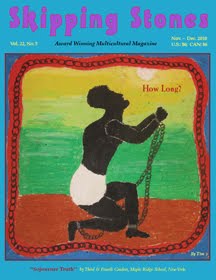
So I submitted my story to Skipping Stones, which should have been my first choice.  Skipping Stones is a children's magazine that celebrates cultural diversity.  They encourage submissions of creative informational stories rather than pure fiction.

With a little tweaking, my "creative nonfiction" turned into a "creative informational story."  I rewrote my story to fit the magazine's style of writing.  That's how it should be done.  Skipping Stones Magazine published my story, "My First Jeepney Ride," in their November-December 2010 issue.

Skipping Stones Magazine is an award-winning cultural magazine.  As they put it, "We are committed to facilitating a meaningful exchange of ideas and experiences.  We want to make reading an active experience, relevant to issues confronting children locally and globally."

November - December 2010
I am thrilled to be sharing my culture with children all over the world.  Please pick-up an issue of Skipping Stones and read my story, "My First Jeepney Ride."

LinkWithin

Related Posts Plugin for WordPress, Blogger...