Showing posts with label mentor text. Show all posts

Monday, February 8, 2016

Mentor Texts: Breaking the Fourth Wall in Picture Books

The idea of breaking the fourth wall is eliminating the barrier between reader and story and allowing them in. This allows the readers to immerse themselves into the wonderful world of imagination.


Many picture books use this technique to get readers engaged through a unique interactive experience. Humor and intrigue is a big part of it, which is what makes it so appealing to readers.


My writing mentor Jim challenged me to write my children's story eliminating the fourth wall. I stumbled on its approach so I took the time to study picture books that successfully broke the fourth wall. 


Breaking the fourth wall is nothing new in picture books. Author Crockett Johnson did a marvelous job with his book, HAROLD AND THE PURPLE CRAYON. It has become a classic favorite.

In his book, the story unfolds as the main character, Harold, draws in the book with his purple crayon. Harold doesn't know exactly where the story will take him, but he is in for an adventure and takes the readers along with him. This story is told in third person, but the pictures draw (no pun intended) the readers in through imagination.

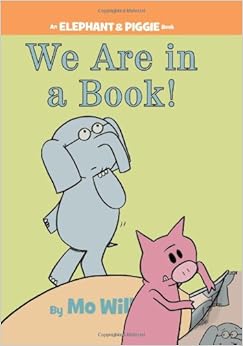
Author Mo Willems is a pro at breaking the fourth wall with his Elephant & Piggie and Pigeon book series. In WE ARE IN A BOOK! the characters talk to each other then break out and refer to the reader. Later, they end up talking to the reader using speech bubbles. There is an interaction between characters, and between characters and the reader.

Piggie!
Yes Gerald?I think someone is looking at us.
A reader! A reader is reading us.
 End: Hello, will you please read us again?


Diagram for We Are in a Book!


Sometimes breaking the fourth wall can get complex as in BIG BAD BUBBLE by Adam Rubin. 


The story is told in second person and starts off like this:
You may not know this, but when a bubble pops, it doesn't just disappear.
Then a character butts in:
Bubbles are sneaky. You never hear them coming…

And now the character and the narrator, who is not revealed, are having a dialogue with each other. But at the same time, because the narrator is outside, we feel as if the character is talking to us, the reader.

Narrator: Don't listen to Mogo…he has no idea what he's talking about.
Character: Bubbles kill thousands of monsters every year.
 Narrator: No, they don't.

 Character: Oh, yeah? Prove it. 


The diagram for this story looks like this:
Diagram for Big Bad Bubble


Activity/Instructions


A simple breaking the fourth wall device is to simply have the character(s) talk to the reader. This is very effective in creating an interaction between character and reader. 


Basic diagram for breaking the fourth wall


In IS THERE A DOG IN THIS BOOK? by Viviane Schwarz, several cats are talking directly to the reader and they are referring to the book that they are a part of. They ask the reader to do something. In this case, cats are inviting readers to lift tabs. This makes them feel a part of the story.

Oh, hi!You opened our book!Come and look at all the pages!

Wait- is there somebody else in this book? 


PRESS HERE by Herve Tullet is a clever and fun interactive picture book that encourages participation. The reader is instructed to do something like "press here," turn the book upside down, and shake it.


My all time favorite classic picture book is THERE IS A MONSTER AT THE END OF THIS BOOK, by Jon Stone. Readers are instructed to NOT to turn the page. Of course, that builds curiosity and leaves readers eventually turning the page. Grover is so adorable in his plea to readers and his fear of what's at the end of the book.


Reader as Narrator


Deborah Underwood, author of HERE COMES THE EASTER CAT uses the simple technique of character and reader interaction. The difference is that the reader becomes the narrator. As the reader reads the book as narrator, the cat is looking outside of the book. There is a private interaction between the reader and the main character, the cat. This technique allows the reader to become part of the story and makes for an exciting and personal experience.


What's wrong, cat? You look grumpy.
Diagram for Here Comes the Easter Cat


Referring to Book as Part of Story


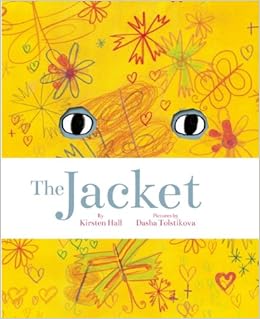
The interaction between characters, narrator, and reader are elements to breaking the fourth wall. Referring to the book itself is another element as in THE JACKET by Kristen Hall. This story is told in third person and is about a favorite book- the (nameless) main character's book. Near the end, the readers are led to believe the book referred to in the story is the very book they are holding because it has the same cover as the book in the story. This is a great technique to get the readers emotionally involved.


Another story that refers to the book in the story is ERNEST THE MOOSE WHO DOESN'T FIT by Catherine Rayner. This is also written in third person. In this story the book comes to life as we see a transformation of the book unfold before our eyes. We see only parts of a moose because he is too large for the pages. Having the character step out of the book transports the reader into another dimension. 


Breaking Out of Character


Characters who go in and out of character as in THIS IS A MOOSE by Richard T. Morris also breaks the fourth wall. 


The story begins like any other story:

This is the Mighty Moose. His father is a moose. His mother is a moose…
This moose wants to be an astronaut.
Then all of a sudden, they break character with:
CUT.
Excuse me, but moose cannot be astronauts…

The characters begin talking with each other and the story switches between the narrator telling the story in third person and natural dialogue between characters.


Diagram for This is a Moose


In CHLOE AND THE LION by Mac Barnett, Barnett himself is talking directly to the reader. His presence is known because we can see him in claymation form as a character in the book. This technique really makes you feel like you are part of the creation process.


 Here is how he starts the book:

This is me, Mac. I'm the author of this book. 
This is my friend, Adam. He's the illustrator of this book. 
And this is Chloe. She's the main character of this book.

Here, readers get a backstage pass into the book process with a formal introduction. This is effective at getting readers invested in the story.

After the introduction, the story begins as third person narrative:

Wherever Chloe went, she looked for loose change.

Not so long after the story begins, we are interrupted by Barnett who takes us out of the imaginary world:
 I'm sorry. Hold on. Adam could you come out here?

This is what it looks like in diagram form:
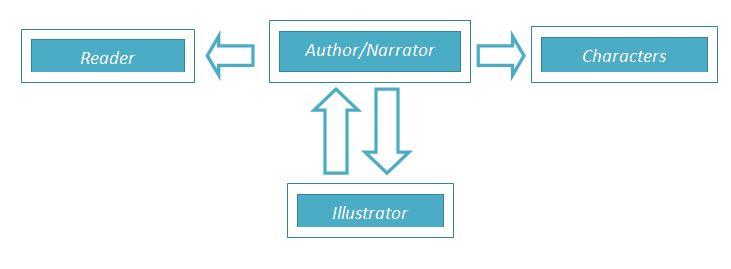

So you see, there are several techniques you could use to break the fourth wall of your story. Experiment with these and find which suits your story best.

After studying these mentor text, I decided that I didn't want a narrator interacting with my characters. Since I had more than one character, I used the character interaction and one sided communication of characters talking to readers as in the diagram of This is Not a Book by Mo Willems. This process of studying mentor text helped me to see the different ways to approach breaking the fourth wall. May it help you.

 -------------------------------------------------
Mentor text for breaking the fourth wall:

THIS IS A MOOSE by Richard T. Morris

 ERNEST THE MOOSE WHO DOESN'T FIT by Catherine Rayner

THE JACKET by Kristen Hall

HERE COMES THE EASTER by Deborah Underwood

THERE IS A MONSTER AT THE END OF THIS BOOK by Jon Stone.

IS THERE A DOG IN THIS BOOK? by Viviane Schwarz

PRESS HERE by Herve

BIG BAD BUBBLE by Adam Rubin

GERALD AND PIGGIE by Mo Willems

HAROLD AND THE PURPLE CRAYON by Crockett Johnson

CHLOE AND THE LION by Mac Barnett

Tuesday, June 2, 2015

The HOW-TO of Mentor Text

There's been a surge for the use of mentor text in classrooms by students and teachers, and by writers. A few months ago Carrie Charlie Brown hosted an event that she created- Reading For Research Month (ReFoReMo) to help writers improve their craft.

I have to admit I've never really understood HOW to use mentor texts until I participated in ReFoReMo. If you'd like to learn about my methods of research, you can read about it on Carrie's blog.

I'm guest-posting today! 


Saturday, May 9, 2015

My Top Picks for Favorite Picture Books

It's the last week of celebrations over at Wordsmith Studios and today we discuss what we are reading.

I read picture books.

There. I said it. I am a grown woman, a health professional, a triathlete, a married mother of two tween boys, and my favorite books are picture books.

After a full day of discussing the cause and effect of bacterial plaque and the prevention of periodontal disease to my patients, running/biking/swimming for an hour or more, chauffeuring my kids here and there, re-learning trigonometry to help with my freshman son's homework...all I want to do at the end of the day is relax with a short, funny book that I can finish in the night without having to fall asleep midway through the first chapter. Picture books.

I love picture books. I write picture books. I read picture books.

It's May and I've already read 113 books this year!


Since I go through picture books like it's candy, I'm going to share with you my favorite[s]. Yes, plural. I have so many favorite picture books that I can't pick just one. So I'm going to share with you my top 10!

Looking at my list, I can tell you that I gravitate towards humorous books that are on the quirky/goofy side, but with heart.

In no particular order:


Planet Kindergarten Planet KindergartenPlanet Kindergarten by Sue Ganz-Schmitt

PLANET KINDERGARTEN is a fun, engaging story that is told from the unique perspective of a child. The MC imagines his school is in outer space and experiences an exploration of his lifetime. Author Sue Ganz-Schmitt manages to capture the authentic emotions that children experience on their first day of school.


The MonstoreThe Monstore by Tara Lazar

What's not to love about a Monstore- a store that sells monsters! Tara Lazar's language and word choice are superb. It makes a fun read aloud. Illustrator, James Burks, did an outstanding job of bringing the characters to life. Kids will have a field day thinking of the monsters they'd like to have.


Prudence Wants a PetPrudence Wants a Pet by Cathleen Daly

Prudence wants a pet so badly that she even goes so far as to get one on her own- a branch, a twig, an old shoe, etc. This book is so funny you can't help but laugh out loud. Cathleen Daly did a wonderful of characterizing Prudence as a sweet and clever child that you can't help but empathize and fall in love with her.


 CarnivoresCarnivores by Aaron Reynolds

I adore this book! Aaron Reynolds did a fantastic job of instilling in our hearts the importance of self appreciation. I love the message that sometimes others can be misunderstood in a hilarious way.

A small note of warning: Not ideal for the sensitive reader. A few characters do get hurt in the story-telling of this book. On a side note, it makes for good discussion and lesson about ecology and the nature of things.


Sophie's SquashSophie's Squash by Pat Zietlow Miller

A delightful story about a little girl named Sophie who takes a friend, Bernice, wherever she goes. But Bernice happens to be a squash, which makes this story hilarious, yet endearing. Sophie's positiveness is infectious. I also love the subtle lesson on the cycle of life that is intertwined with the story.


Creepy Carrots!Creepy Carrots! by Aaron Reynolds

Twilight Zone meets The Shining in this hilarious picture book by Aaron Reynolds. I've always been a fan of the Twilight Zone series so this one grabbed and sustained my attention throughout the reading. In Creepy Carrots, a rabbit fears that his favorite food is after him. You will never look at a carrot the same way again.


Mr. Tiger Goes WildMr. Tiger Goes Wild by Peter  Brown

Mr. Tiger, sporting a top hat, coat and tie, is a proper tiger. Unhappy with his mundane life, he decides to let loose and follow his animal instincts. With sparse text and lovely illustrations, this story conveys the universal message, be yourselves, in a brilliant and humorous way.

The Day the Crayons QuitThe Day the Crayons Quit by Drew Daywalt

This is one of those books I wished I could have written. Duncan wants to color, but when he opens his crayon box, he finds letter after letter from each colored crayon protesting about the unfairness that goes on in the coloring box. It is original, clever, fresh, and oh, so FUNNY!


The last two books are not humorous picture books, but they stood out to me as beautifully written picture books that pulled my heart-strings.


City Dog, Country FrogCity Dog, Country Frog by Mo Willems

A poignant story of friendship between a dog and a frog written with beautiful language and eloquent style. It is also about loss that is told in a sensitive manner that children can comprehend. The four seasons depicted in the story brilliantly brings us to another emotional level.


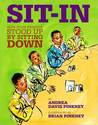
Sit-In: How Four Friends Stood Up by Sitting DownSit-In: How Four Friends Stood Up by Sitting Down by Andrea Davis Pinkney

Wow! Picture books are difficult to write, let alone a historical nonfiction story. In a few word, author Andrea Pinkney, writes a powerful poetic story of four college students staging a peaceful protest by sitting at an all-white diner counter. A civil-rights story of courage and equality.


View all my reviews


Again, it was difficult for me to narrow my list to top 10 so I'm going to share with you five more as Honorable Mentions:

This Is a MooseThis Is a Moose by Richard T. Morris


 MapleMaple by Lori Nichols


I Don't Want to Be a FrogI Don't Want to Be a Frog by Dev Petty


 This Orq. (He Cave Boy.)This Orq. by David Elliott


The Three Ninja PigsThe Three Ninja Pigs by Corey Rosen Schwartz


Hope you get a chance to check out these books. There's nothing like a picture book to melt your stress away.

"Writing is like a vacation. I get to travel anywhere my imagination takes me" ~Romelle Broas

View all my reviews on Goodreads.


My name is Romelle and I read picture books! 


To see what other Wordsmith Studio Members are reading, join the blog hop below:

Wednesday, October 1, 2014

Mentor Text and Readability Scores

It's been a while since I've posted on my blog. It's because I've been burying myself in nonfiction picture books!  


I blame Kristen Fulton's wonderful nonfiction picture book writing class, Nonfiction Archaeology, for my fixation. 

I am familiar with writing nonfiction for magazines, but writing nonfiction picture books is a different animal for me. To help me get into the zone, I've immersed myself in nonfiction picture books. Below are few of my favorite (recent) reads that I am using as mentor text. 


What I find challenging is writing for my target population. It's so easy to want to present all the facts that sometimes I get carried away with words. To make sure I stay on track, I found a wonderful site that helps me assess my work-in-progress:  http://www.readability-score.com


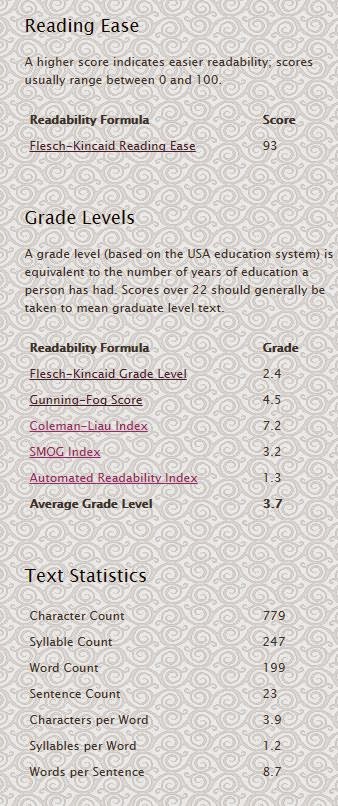
What you do is copy and paste your completed text in the box and hit enter on your keyboard. The site will analyze your story and give you the following information:


What's useful about this information is that you will know if your writing is targeted to the population you intended to write for. 

The Flesch-Kincaid Reading Ease tells you the difficulty of your text:

90.0-100.0 Easily understood by an average 11-year-old student
60.0 - 70.0 Easily understood by an average 13-15-year-old student
0.0 - 30.0 Easily understood by a university student

Grade Level or Readability Formula Score: There is a mathematical way to determine these scores. You don't have to get caught up with each of these. All you need to know is the average grade level of the student your text is appropriate for.

Text Statistics is always fun, but the most useful is word count and words per sentence. As a writer, you want to make sure you vary your sentence length and keep within the word count that is suggested on submission guidelines. 


Here are a few more sites I found helpful for studying mentor text:

  1. Identify whether you are a student, parent, teacher, or librarian (it doesn't matter)
  2. In the "Quick Search" tab, enter the title of the book you are studying
  3. Your result will look like this: 
  4. Click on the title and you get an expanded form of the results: 


  1. Go to the "Quiz Store"
  2. Enter title of the book you want to study and hit "Go!"
  3. Select the correct title displayed

I apologize for the small and blurry screen shot


To help you decipher the codes, here is a cheat sheet:

Interest Level (IL): This indicates the grade level the book is appropriate for, based on book content (theme, character, plot). Lower Grade indicates grade level K-3, Middle grade: 4-8, and upper grade: 9-12.

Book Level (BL): This represents the difficulty of the text. It means the text could be read independently by a student whose reading skills are at the grade level indicated.

AR Points (Accelerated Reader Points): This is based on the difficulty and length of the book. A point value system measures how much reading practice your child is getting. Not important, but thought you'd want to know.


The difference between the Renaissance Learning site and the AR Book Finder is that the AR Book Finder includes a rating of the book, judged by students based on enjoyment. It also includes a topic-subtopic, which is useful to know if you want to know how the book is sorted or categorized.


My top three Readability Score sites:

Readability-score
AR BOOK FINDER
Renaissance Learning

Give the links a test ride and tell me what you think!

LinkWithin

Related Posts Plugin for WordPress, Blogger...