Showing posts with label resources. Show all posts

Monday, May 23, 2016

The Nevada SCBWI Mentorship Experience- Part II

So You Want to Become a Mentee

for the Nevada SCBWI Mentor Program

OR

You Want a Mentor


First, you need to know what you want in a mentor.

Here are my personal top 3 qualities I look for in a mentor:

1) Tall

2) Dark

3) Handsome

Well, looky-looky here. As luck would have it, my mentor Jim happened to fit the bill! 

http://www.jimaverbeckbooks.com/


Okay, these qualities are more like bonuses. Below are the qualities to really look for in a mentor. Really. 

Here are my TOP 10.

A good writing mentor is someone who is:

  • Experienced in your genre and willing to share their skills, knowledge, and expertise
  • Interested in your development as a writer and your success
  • Respected in the industry or has great references
  • Easy to reach
  • Devoted and willing to spend time and energy mentoring and guiding you
  • Up-to-date with the market
  • Interested in knowing your strengths and weaknesses and building from it
  • Honest with their feedback and gives constructive criticism
  • Organized
  • Supportive
The Nevada SCBWI Mentor Program has some of the best mentors in the industry. Check the website for updates on mentor panels.


From their website [via Lia Keyes]:
“Past mentors have included National Book Award Finalists, New York Times bestselling authors, Caldecott Medal–winning illustrators, Coretta Scott King Award winners, Charlotte Zolotow Award winners, million-selling series authors, art directors, editors, publishers, and agents. We hand-pick mentors who are gifted both at creating children’s books and at teaching. Many Nevada Mentor Program alumnae have gone on to win awards, land agents, and sign book deals.”

How to Apply for the Nevada SCBWI Mentor Program

Visit the SCBWI Nevada Chapter for more information

Here is the gist of it:
  • Fill out the required application
  • Send in three of your most promising manuscripts.
  • Choose two mentors you'd like to possibly work with in order of preference.
  • Your manuscripts will be given to your choices.
  • The mentors then read the [blind] manuscripts given to them.
  • Mentors choose two (sometimes three) they feel have promise.
  • Hopefully, one of the two mentors you've selected has chosen you to work with.

The Nevada SCBWI Mentor Program is a one-of-a-kind experience. Curious about what goes on? You can read my story here

TIPS
  • Choose your best work for submission. (You'd be amazed at how much more can be improved. If you are sending a picture book, many times the mentor will allow up to three to work on. If you are chosen as a mentee, you can ask if your mentor will be willing to look at a different manuscript you'd prefer to work on.)
  • Choose a mentor experienced in your genre
  • Avoid choosing a mentor in hopes of that editor/agent representing you. Choose them for their mentorship!
  • Take advantage of their expertise. Don't be afraid to ask questions during the six-month course. You may want to create a list of questions ahead of time so you don't end the program with any regrets.


CAVEAT [not to be confused with Caviar]

The price of the Nevada Mentorship Program is steep. 

If you have to travel far to get to Reno, you need to factor that into the price of tuition since transportation is not included.

You can probably find a mentor for fraction of the cost of the Nevada Mentorship Program. But remember, tuition includes mentorship, craft intensive workshops, lodging, and most meals. 

Please note that the six-month program doesn't mean you are away for six months. It means, you get to work with your mentor for six months. There are two (separate) 3-day weekend retreats. One at the start of the program, the other at the end. 

The Nevada Mentorship Experience, the support, friendships, the networking with agents, editors, authors, and the relationships built are priceless. 

At the retreats you sleep, eat, mingle with agents, editors, and authors. It's the "dorm room" experience which gives the program a more intimate appeal.

Communication varies with each mentor, ranging from emails, Skype, and phone calls. Usually your one-on-one is limited to an hour at a time, three times during the six-month program. You will not know the arrangement until your first meeting with your mentor.

Everyone's mentorship experience is unique to their mentor-mentee relationship, which is why it is so important to choose your mentor wisely!

~ Happy Writing!

For more on the experience visit:


To Apply Visit:

Monday, February 8, 2016

Mentor Texts: Breaking the Fourth Wall in Picture Books

The idea of breaking the fourth wall is eliminating the barrier between reader and story and allowing them in. This allows the readers to immerse themselves into the wonderful world of imagination.


Many picture books use this technique to get readers engaged through a unique interactive experience. Humor and intrigue is a big part of it, which is what makes it so appealing to readers.


My writing mentor Jim challenged me to write my children's story eliminating the fourth wall. I stumbled on its approach so I took the time to study picture books that successfully broke the fourth wall. 


Breaking the fourth wall is nothing new in picture books. Author Crockett Johnson did a marvelous job with his book, HAROLD AND THE PURPLE CRAYON. It has become a classic favorite.

In his book, the story unfolds as the main character, Harold, draws in the book with his purple crayon. Harold doesn't know exactly where the story will take him, but he is in for an adventure and takes the readers along with him. This story is told in third person, but the pictures draw (no pun intended) the readers in through imagination.

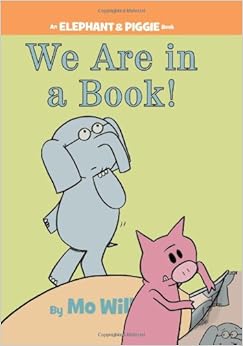
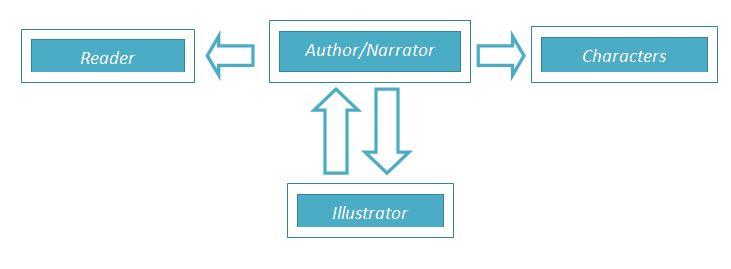
Author Mo Willems is a pro at breaking the fourth wall with his Elephant & Piggie and Pigeon book series. In WE ARE IN A BOOK! the characters talk to each other then break out and refer to the reader. Later, they end up talking to the reader using speech bubbles. There is an interaction between characters, and between characters and the reader.


Piggie!
Yes Gerald?I think someone is looking at us.
A reader! A reader is reading us.
 End: Hello, will you please read us again?


Diagram for We Are in a Book!


Sometimes breaking the fourth wall can get complex as in BIG BAD BUBBLE by Adam Rubin. 


The story is told in second person and starts off like this:
You may not know this, but when a bubble pops, it doesn't just disappear.
Then a character butts in:
Bubbles are sneaky. You never hear them coming…

And now the character and the narrator, who is not revealed, are having a dialogue with each other. But at the same time, because the narrator is outside, we feel as if the character is talking to us, the reader.

Narrator: Don't listen to Mogo…he has no idea what he's talking about.
Character: Bubbles kill thousands of monsters every year.
 Narrator: No, they don't.

 Character: Oh, yeah? Prove it. 


The diagram for this story looks like this:
Diagram for Big Bad Bubble


Activity/Instructions


A simple breaking the fourth wall device is to simply have the character(s) talk to the reader. This is very effective in creating an interaction between character and reader. 


Basic diagram for breaking the fourth wall


In IS THERE A DOG IN THIS BOOK? by Viviane Schwarz, several cats are talking directly to the reader and they are referring to the book that they are a part of. They ask the reader to do something. In this case, cats are inviting readers to lift tabs. This makes them feel a part of the story.

Oh, hi!You opened our book!Come and look at all the pages!

Wait- is there somebody else in this book? 


PRESS HERE by Herve Tullet is a clever and fun interactive picture book that encourages participation. The reader is instructed to do something like "press here," turn the book upside down, and shake it.


My all time favorite classic picture book is THERE IS A MONSTER AT THE END OF THIS BOOK, by Jon Stone. Readers are instructed to NOT to turn the page. Of course, that builds curiosity and leaves readers eventually turning the page. Grover is so adorable in his plea to readers and his fear of what's at the end of the book.


Reader as Narrator


Deborah Underwood, author of HERE COMES THE EASTER CAT uses the simple technique of character and reader interaction. The difference is that the reader becomes the narrator. As the reader reads the book as narrator, the cat is looking outside of the book. There is a private interaction between the reader and the main character, the cat. This technique allows the reader to become part of the story and makes for an exciting and personal experience.


What's wrong, cat? You look grumpy.
Diagram for Here Comes the Easter Cat


Referring to Book as Part of Story


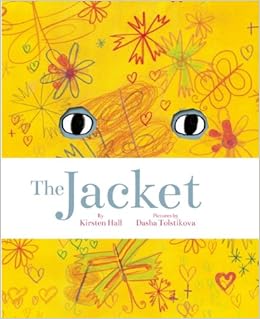
The interaction between characters, narrator, and reader are elements to breaking the fourth wall. Referring to the book itself is another element as in THE JACKET by Kristen Hall. This story is told in third person and is about a favorite book- the (nameless) main character's book. Near the end, the readers are led to believe the book referred to in the story is the very book they are holding because it has the same cover as the book in the story. This is a great technique to get the readers emotionally involved.


Another story that refers to the book in the story is ERNEST THE MOOSE WHO DOESN'T FIT by Catherine Rayner. This is also written in third person. In this story the book comes to life as we see a transformation of the book unfold before our eyes. We see only parts of a moose because he is too large for the pages. Having the character step out of the book transports the reader into another dimension. 


Breaking Out of Character


Characters who go in and out of character as in THIS IS A MOOSE by Richard T. Morris also breaks the fourth wall. 


The story begins like any other story:

This is the Mighty Moose. His father is a moose. His mother is a moose…
This moose wants to be an astronaut.
Then all of a sudden, they break character with:
CUT.
Excuse me, but moose cannot be astronauts…

The characters begin talking with each other and the story switches between the narrator telling the story in third person and natural dialogue between characters.


Diagram for This is a Moose


In CHLOE AND THE LION by Mac Barnett, Barnett himself is talking directly to the reader. His presence is known because we can see him in claymation form as a character in the book. This technique really makes you feel like you are part of the creation process.


 Here is how he starts the book:

This is me, Mac. I'm the author of this book. 
This is my friend, Adam. He's the illustrator of this book. 
And this is Chloe. She's the main character of this book.

Here, readers get a backstage pass into the book process with a formal introduction. This is effective at getting readers invested in the story.

After the introduction, the story begins as third person narrative:

Wherever Chloe went, she looked for loose change.

Not so long after the story begins, we are interrupted by Barnett who takes us out of the imaginary world:
 I'm sorry. Hold on. Adam could you come out here?

This is what it looks like in diagram form:


So you see, there are several techniques you could use to break the fourth wall of your story. Experiment with these and find which suits your story best.

After studying these mentor text, I decided that I didn't want a narrator interacting with my characters. Since I had more than one character, I used the character interaction and one sided communication of characters talking to readers as in the diagram of This is Not a Book by Mo Willems. This process of studying mentor text helped me to see the different ways to approach breaking the fourth wall. May it help you.

 -------------------------------------------------
Mentor text for breaking the fourth wall:

THIS IS A MOOSE by Richard T. Morris

 ERNEST THE MOOSE WHO DOESN'T FIT by Catherine Rayner

THE JACKET by Kristen Hall

HERE COMES THE EASTER by Deborah Underwood

THERE IS A MONSTER AT THE END OF THIS BOOK by Jon Stone.

IS THERE A DOG IN THIS BOOK? by Viviane Schwarz

PRESS HERE by Herve

BIG BAD BUBBLE by Adam Rubin

GERALD AND PIGGIE by Mo Willems

HAROLD AND THE PURPLE CRAYON by Crockett Johnson

CHLOE AND THE LION by Mac Barnett

Monday, March 2, 2015

Debut Author Interview with Donna L. Martin

Big Break with a Small Publisher


Do you have a story idea that is for the niche market?
Do you want personal attention and have some say in the publication of your book?
Are you an unpublished writer waiting to be discovered?

Then small publishers may be for you. 


Debut Author, Donna L. Martin made a big break with Anaiah Press with her book, THE STORY CATCHER. 


In this interview, Donna will share her publishing journey with us, which started with a Pitch Party on Twitter that resulted in an unexpected surprise.  
After the interview, I've included a resource of small presses you may be interested in, along with some helpful information to help you decide whether small presses are for you.
You don't want to miss this! So sit back, relax, and get inspired with Donna!

Tell me about your book and the inspiration for your story idea.

My debut picture book, THE STORY CATCHER, is about a little girl's struggle to make the wiggly words of her favorite book sit still long enough for her to be able to catch them and read a story.  I tutored a young girl a few years ago who had a learning disability and was unable to read on her grade level. After working with her for the entire school year, she was finally able to read on her own. That experience of a child struggling with a learning disability was the basis of this story.

Do you have an agent? If not, what made you decide to submit on your own?
No, I don't have an agent at this time but I am looking for one. After two years of searching for one, I found out about a Twitter Pitch Party where picture book manuscripts were allowed and just took a chance. It was supposed to be mainly agents so I really didn't think about an editor requesting my book.

How did you learn of Anaiah Press and what drew you to them?
I had never heard of Anaiah Press before the pitch party. I decided to go with them because I was so impressed with my editor, Jessica Schmeidler. She had an open communication style that matched mine and I could tell she was really passionate about her author's works. I knew I could trust her with the future of my story.

What benefits do you see publishing with a small press?
Small presses with small catalog lines might have easier submission guidelines and be more willing to take on an untried writer. Small presses have smaller staff numbers so authors have a better chance of connecting with high level individuals who are responsible for the decision making. 

Does Anaiah help with the marketing of your book?
Anaiah offers a number of marketing support to their authors including blog posts, book cover reveals, book trailers, and blog tours.

What have you done to promote your book?
Book marks, business cards, car magnets, school visits, author visits to Barnes & Noble, contests and giveaways, blog tours, book reviews, book submissions to book awards, book submissions to my local library acquisitions committee, future participation in my city's annual Children's Festival of Reading where up to 15,000 people will be able to sign up for my STORY CATCHER FAN CLUB.

What are you working on now? Any new stories in the works?
Currently I have 11 completed picture books, 2 completed early reader chapter books (one martial arts based fiction and one creative nonfiction), and two young adult works in progress (one mystery and one fantasy), along with research on my next creative nonfiction story.

Fun Facts
When did you write the first draft of STORY CATCHER: 2013

Number of months before you felt STORY CATCHER was submission-ready: 6 months

How many months was it from the time of submission to acceptance with Anaiah Press: 1 day

Number of months from the time of contract to publication with Anaiah Press: 11 months
The number of publishing houses you submitted to prior to your contract with Anaiah Press: ZERO

Thank you so much for sharing your journey with us Donna! For more on THE STORY CATCHER, check out this fabulous video:


Donna would love to hear from you! Check out her Facebook fan page, drop her an email, join her STORY CATCHER fan club or find out what interests Donna on Twitter or Pinterest:

Author Email: 
donasdays@gmail.com
Story Catcher Fan Club Email: 
storycatcherfanclub@gmail.com


***************

For more on the pros and cons of small press publishing, check out the links below:

Robert Brewer of Writer's Digest goes into detail with a three-part assessment: Submissions Process, Publishing Process, and Career Building. He interviews authors about their experiences working with small presses and with publishers about what they expect from authors and what they offer.

Agent Rachelle Gardner of Books and Such Literary Agency invites guest blogger and author, Jessica Knauss, to discuss the pros and cons of small presses. Jessica's post is based on her personal experiences and gets to the meat of the topic with bullet points, which makes it a quick and easy read.

Literary Agent, Carly Watters gives us her personal opinion on the disadvantages of seeking an agent and a publisher simultaneously with a focus on small presses.


For a list of small publishers, check out my personal link here.


If there are any small publishers you've had experiences with, have submitted to, or know of that I've missed on my list, please share them with me in the comments below. Thank you!

LinkWithin

Related Posts Plugin for WordPress, Blogger...